






US Indexes Mixed as Big- and Small-Caps Advance While Technology Sell-Off Deepens
The Canadian Vanguard Stock Market Report – Tuesday November 24, 2026 Edition
.
The Toronto Market
Tuesday’s Toronto Market Index
The S&P/TSX Composite Index fell 119.82 points, or 0.35%, to close at 33,962.30 today.
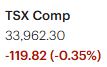

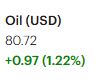
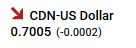
The Toronto market’s strong rebound yesterday failed to generate enough momentum to sustain its bullish performance into today’s session. Although resource, energy, and financial stocks helped drive Monday’s recovery, that positive momentum quickly faded.
The damage inflicted on the TSX over the past two weeks has been considerable. The index remains below its 21-day, 50-day, and 200-day moving averages, reflecting a deteriorating technical picture and a persistent downward trend. The resource-heavy Toronto market continues to struggle, as its major sectors have been unable to generate the sustained buying pressure needed to restore a consistent upward trajectory.
The TSX chart is showing increasing technical deterioration, suggesting that the market’s recent weakness is becoming more entrenched rather than simply representing a temporary pullback.
Technical Outlook
The TSX Composite Index closed today’s session below all three key moving averages: the 21-day, 50-day, and 200-day. Its technical position has weakened considerably over the past several weeks.
The risks facing traders and investors have also increased, particularly following the index’s decline below its 50-day moving average. Until the TSX can reclaim these important technical levels and establish a sustained upward trend, the market’s overall technical outlook remains weak and vulnerable to further downside pressure.
Tuesday’s TSX Market Statistics
Market breadth on the TSX was negative today, as declining issues significantly outnumbered advancing issues. Specifically, there were 1,487 decliners compared to 849 advancers, producing a decliner-to-advancer ratio of 1.75 to 1. In other words, there were approximately two declining stocks for every advancing stock. Another 256 issues remained unchanged. Overall, market breadth reflected continued weakness across the Toronto Stock Exchange.
The exchange recorded 26 new 52-week highs and 115 new 52-week lows, compared with 12 new highs and 51 new lows reported yesterday.
The number of new 52-week highs increased by approximately 116% compared with yesterday, while the number of new 52-week lows increased by approximately 125%. Although both figures rose considerably, the increase in new lows remains a concerning indication of underlying market weakness.
The ratio of new 52-week highs to new 52-week lows stood at approximately 23%, or 0.23, today, compared with approximately 22% yesterday. This represents a marginal improvement, suggesting that the relationship between stocks reaching new highs and those falling to new lows has remained relatively stable, with a slight positive shift.
Overall, TSX market internals remain weak. However, there are early indications that some underlying support may be developing. The slight improvement in the new-high-to-new-low ratio is encouraging, and investors will want to see whether this improvement can continue in the coming sessions. For now, market breadth and the number of stocks reaching new 52-week lows continue to signal a vulnerable market environment.
Trading Volume
Total trading volume on the TSX reached 509,379,025 shares today, representing an increase of approximately 58% compared with yesterday’s volume of 322,950,362 shares.
The substantial increase in trading activity indicates that market participation intensified considerably. However, given the negative market breadth and the significantly higher number of declining issues, the heavier volume should be viewed cautiously rather than interpreted as a clear sign of renewed buying strength.
Tuesday’s TSX Market Wrap-Up Report
A Broad but Uneven Market Performance as TSX Momentum Fades
The Toronto Stock Exchange failed to extend Monday’s strong rebound, as the bullish momentum that briefly lifted the market yesterday lost traction during Tuesday’s trading session. Although market performance was mixed, the majority of sectors managed to finish in positive territory. However, the gains across several sectors were not sufficient to offset weakness in key areas of the market, particularly technology and resource-related stocks.
The S&P/TSX Composite Index declined 119.82 points, or 0.35%, to close at 33,962.30. Despite 15 of the 20 sectors advancing, the overall market finished lower, highlighting the uneven nature of Tuesday’s trading activity.
Communications was the strongest-performing sector, surging 12.14%. Health Technology and Technology Services also posted respectable gains of 1.74% and 1.56%, respectively. Retail Trade advanced 1.26%, while Consumer Services gained 1.13%. Transportation rose 0.85%, and Energy Minerals added 0.76%.
However, the financial sector remained under pressure. Finance declined 0.15%, as all six of Canada’s major banks finished in negative territory. The banking stocks have struggled to establish a sustained recovery over the past couple of months, and Tuesday’s performance offered little encouragement that this weakness is about to reverse.
On the downside, Producer Manufacturing declined 0.37%, while Non-Energy Minerals fell 2.92%. Electronic Technology was the weakest-performing sector, plunging 5.31% and emerging as the TSX’s biggest sector laggard.
The performance of the technology and resource-related sectors remains particularly important because of their influence on market sentiment and the broader direction of the Canadian equity market.
TSX Market Breadth and Trading Activity
Despite the fact that 15 of the 20 sectors advanced, the underlying market statistics painted a considerably weaker picture.
Declining issues outnumbered advancing issues by a substantial margin. There were 1,487 decliners compared with 849 advancers, producing a decliner-to-advancer ratio of approximately 1.75 to 1. Another 256 issues remained unchanged.
This negative market breadth suggests that the weakness was more widespread across individual stocks than the headline index performance alone might indicate.
The exchange also recorded 26 new 52-week highs against 115 new 52-week lows. This compares with 12 new highs and 51 new lows yesterday. Both figures increased considerably, but the substantially larger number of new lows remains a concerning indication of underlying market weakness.
The ratio of new 52-week highs to new 52-week lows improved slightly to approximately 0.23, or 23%, compared with 0.22, or 22%, yesterday. Although this represents a marginal improvement, the number of stocks establishing new lows remains considerably greater than the number reaching new highs.
Trading activity also increased substantially. Total TSX volume reached 509.38 million shares, approximately 58% higher than yesterday’s 322.95 million shares.
The combination of heavier trading volume, negative market breadth, and a significantly greater number of new 52-week lows deserves attention. Higher volume accompanied by declining issues does not necessarily indicate institutional selling, but it does suggest that Tuesday’s market weakness occurred amid considerably increased trading participation.
Individual Stock and Company News
Kinaxis Inc.
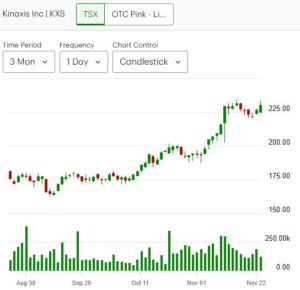
Kinaxis Inc. recently hosted its inaugural two-day event in Mumbai, India, highlighting the growing importance of the Indian market and its workforce to the company’s global operations.
Kinaxis maintains teams in Chennai and Bangalore that support product development, engineering, professional services, and customer success. India has become an important component of the company’s international operating structure.
The company continues to invest in research and development in India, with an emphasis on strengthening its engineering and innovation capabilities to support the next generation of artificial intelligence and supply chain orchestration technologies.
For investors, Kinaxis’ continued investment in its technology capabilities and international operations reflects its longer-term commitment to innovation and growth in the supply chain management industry.
Cameco Corporation (TSX: CCO)
Resource and energy-related stocks continue to experience uneven performance, contributing to the challenges facing the broader TSX.
Shares of Cameco Corporation (CCO) declined 3.52% to close at C$85.26 on Tuesday, making it another difficult trading session for the uranium producer.
The weakness in Cameco is worth monitoring, particularly given the importance of resource-related companies to the Toronto market. Continued weakness among major resource stocks could make it more difficult for the TSX to establish a sustained recovery.
Canada’s Big Six Banks
All six of Canada’s major banks finished Tuesday’s session in negative territory.
The banking sector has been struggling to generate sustained upward momentum over the past couple of months, and today’s losses suggest that the recent weakness remains unresolved.
Monday’s positive market performance had offered some hope that financial stocks might begin participating more consistently in a broader market recovery. However, Tuesday’s reversal suggests that the improvement may have been temporary.
Given the considerable influence of Canada’s major banks on the TSX Composite Index, their continued underperformance represents an important obstacle to a stronger and more sustainable market recovery.
Alamos Gold Inc. (TSX: AGI) and Trident Resources
According to reports, Alamos Gold Inc. (TSX: AGI) has agreed to invest C$25.9 million in Trident Resources (TSXV: ROCK), acquiring a 14.9% equity stake in the company through a private placement.
Under the agreement, Alamos will acquire approximately 7.4 million Trident shares at C$3.49 per share.
Alamos indicated that the shares were acquired for investment purposes.
The investment represents a strategic equity position in Trident and is another development worth monitoring within Canada’s gold and mineral exploration sector.
Technical Outlook: The TSX Remains Vulnerable
From a technical perspective, the TSX Composite Index remains in a weakened position.
The index closed Tuesday below its 21-day, 50-day, and 200-day moving averages. Its technical condition has deteriorated considerably over the past several weeks, and the inability to sustain Monday’s rebound raises further questions about the strength of the market’s underlying recovery.
Of particular concern is the index’s position below its 50-day moving average. A sustained move below this widely followed technical indicator can signal deteriorating intermediate-term momentum and increase the risks facing traders and investors.
The index also remains below its 200-day moving average, suggesting that the weakness is not limited to a short-term trading setback.
For the TSX to establish a more convincing recovery, investors will want to see the index reclaim these important moving averages, accompanied by improving market breadth, stronger participation from the financial sector, and renewed leadership from resource and energy stocks.
Until those developments occur, rallies should be approached with caution.
Key Takeaways for Traders and Investors
1. Monday’s rebound has not yet established a sustainable market recovery.
Tuesday’s decline suggests that the TSX still lacks the momentum necessary to reverse its recent deterioration. Traders should be cautious about interpreting a single strong trading session as confirmation of a trend reversal.
2. Market breadth remains a significant concern.
Decliners outnumbered advancers by approximately 1.75 to 1. Furthermore, 115 stocks reached new 52-week lows compared with only 26 new highs. These figures indicate that underlying market weakness remains widespread despite the positive performance of most sectors.
3. Watch the banking sector closely.
All six major Canadian banks finished lower. Given their importance to the TSX, a sustained recovery in financial stocks would be an important development in determining whether the broader market can regain upward momentum.
4. Resource and technology stocks remain important areas of weakness.
The significant decline in Electronic Technology and the weakness in Non-Energy Minerals highlight the uneven nature of sector performance. Investors should continue monitoring these areas for signs of stabilization or further deterioration.
5. Higher trading volume requires careful interpretation.
TSX volume increased approximately 58% compared with Monday. However, the combination of higher volume and negative market breadth does not provide convincing evidence of renewed buying strength.
6. The moving averages remain important technical benchmarks.
With the TSX trading below its 21-day, 50-day, and 200-day moving averages, the technical outlook remains vulnerable. Traders may want to exercise greater selectivity, manage position sizes carefully, and avoid assuming that short-term rebounds represent confirmed trend reversals.
Overall Market Assessment
Tuesday’s trading session was a reminder that the Toronto market has not yet overcome the damage inflicted during the past several weeks.
Although 15 of the 20 sectors advanced, the S&P/TSX Composite Index still finished lower. Negative market breadth, a substantial increase in new 52-week lows, and continued weakness among Canada’s major banks point to an underlying market that remains fragile.
The slight improvement in the ratio of new highs to new lows offers a small positive development, but it is far too early to interpret this as a meaningful change in market direction.
For now, the TSX remains technically weakened and vulnerable to further downside pressure. Traders and investors should remain disciplined and look for stronger confirmation from market breadth, sector leadership, and the index’s ability to reclaim its key moving averages before adopting a more optimistic market outlook.
The bottom line: Monday’s rebound was encouraging, but Tuesday’s performance suggests that the Toronto market still has considerable work to do before a sustainable bullish recovery can be established.
.
The US Markets
Tuesday’s US Market Indexes
Major US Indexes Deliver a Mixed Performance
The major US stock market indexes finished Tuesday’s trading session mixed, as the positive momentum from Monday’s market rebound failed to carry across the broader market.
The Dow Jones Industrial Average advanced 423.39 points, or 0.85%, to close at 50,018.70. The S&P 500 declined 36.08 points, or 0.50%, finishing at 7,201.09. The Nasdaq Composite suffered a larger setback, falling 356.02 points, or 1.48%, to close at 23,733.56. Meanwhile, the Russell 2000 gained 15.29 points, or 0.57%, ending the session at 2,684.94.

The Dow Jones and Russell 2000 continued their positive performance from Monday, while the S&P 500 and Nasdaq Composite failed to sustain yesterday’s upward momentum.
The divergence between the major indexes suggests that Tuesday’s market recovery was uneven. Although the Dow and small-cap stocks managed to advance, technology-related stocks came under renewed selling pressure, weighing heavily on the Nasdaq Composite.
Nasdaq Composite: Technical Damage Remains a Concern
The Nasdaq Composite’s technical picture remains concerning.
The index closed Tuesday below its 21-day and 200-day moving averages and approximately 1,500 points below its 50-day moving average. The relationship between these three moving averages is particularly noteworthy.
The 21-day and 200-day moving averages are currently positioned close to one another, while the 50-day moving average remains substantially higher. In other words, the short-term and long-term moving averages have converged, but the intermediate-term average remains elevated above both.
This configuration reflects a technically weakened market structure. The Nasdaq has experienced considerable deterioration, and its chart requires significant repair before a more convincing bullish outlook can be established.
For traders and investors, the immediate challenge is determining whether the index can stabilize and regain its key moving averages. Until that happens, rallies should be treated cautiously, particularly given the substantial distance separating the index from its 50-day moving average.
Russell 2000: A Positive Session Against a Bearish Technical Background
The Russell 2000 delivered a more encouraging performance on Tuesday, advancing 0.57% and extending Monday’s positive momentum.
However, the index’s underlying technical condition remains weak. Despite today’s advance, the Russell 2000 continues to trade below its 21-day, 50-day, and 200-day moving averages.
Of particular concern is the recent bearish crossover between the 50-day and 200-day moving averages. This formation is commonly referred to as a Death Cross and is widely regarded as a bearish technical signal.
A Death Cross occurs when the intermediate-term 50-day moving average moves below the longer-term 200-day moving average. It can indicate that a shorter-term market decline has developed into a more established intermediate-term downtrend.
The recent crossover is therefore an important warning sign for small-cap investors. Although Tuesday’s advance represents a meaningful improvement from Friday’s weakness, one or two positive trading sessions are not sufficient to reverse the broader technical deterioration.
The Russell 2000 needs to reclaim its important moving averages and eventually reverse the bearish crossover before its technical outlook can be considered substantially improved.
For now, traders should exercise additional caution when trading small-cap stocks. The index’s inability to regain its key technical levels leaves it vulnerable to renewed selling pressure.
Key Takeaways for Traders and Investors
1. The US market recovery remains uneven.
The Dow Jones and Russell 2000 advanced, but the S&P 500 and Nasdaq declined. This divergence suggests that the broader market has not yet established a consistent bullish direction.
2. Technology stocks remain an area of concern.
The Nasdaq’s 1.48% decline was considerably larger than the losses in the S&P 500. Its position below the key moving averages indicates that technology-related market weakness remains unresolved.
3. The Russell 2000’s Death Cross deserves attention.
The bearish crossover between the 50-day and 200-day moving averages is a warning that the small-cap market may be experiencing a broader intermediate-term downtrend. Traders should avoid interpreting today’s positive performance as confirmation of a trend reversal.
4. Moving averages remain important technical benchmarks.
The Nasdaq and Russell 2000 both remain in technically weakened positions. Investors should monitor whether these indexes can reclaim their respective moving averages and establish sustained upward momentum.
5. Be selective and manage risk.
Until the technical picture improves, traders may want to exercise greater selectivity, avoid chasing short-term rallies, and pay particular attention to position sizing and downside risk.
Overall US Market Assessment
Tuesday’s US market performance was mixed, reflecting a market that continues to struggle with uneven momentum and deteriorating technical conditions in important segments.
The Dow Jones and Russell 2000 managed to extend Monday’s positive performance, but the Nasdaq’s substantial decline and the S&P 500’s retreat suggest that the recovery is not yet broad or sufficiently established.
The technical conditions of the Nasdaq and Russell 2000 remain particularly concerning. Both indexes are trading below their key moving averages, while the Russell 2000’s recent Death Cross adds another layer of caution for small-cap investors.
Although Tuesday’s gains in the Dow and Russell 2000 are encouraging, traders and investors should wait for stronger technical confirmation before assuming that the market has entered a sustainable recovery.
The bottom line: The US market is showing signs of selective strength, but the underlying technical picture remains fragile. Caution, selectivity, and disciplined risk management remain appropriate until the major indexes demonstrate a more convincing and sustained recovery.
.
Tuesday’s US Market Statistics
New York Stock Exchange (NYSE): Market Internals Show Signs of Improvement
Market breadth on the New York Stock Exchange (NYSE) was positive on Tuesday, as advancing issues outnumbered declining issues. Specifically, there were 1,447 advancers compared with 1,263 decliners, while another 86 issues remained unchanged.
This produced an advancer-to-decliner ratio of approximately 1.14 to 1, meaning there were roughly six advancing stocks for every five declining stocks. Although the margin was relatively narrow, the positive breadth suggests that buying activity had a modest advantage across the exchange.
The NYSE recorded 39 new 52-week highs and 160 new 52-week lows, compared with 21 new highs and 134 new lows yesterday.
The number of new 52-week highs increased by approximately 85% compared with yesterday, while new 52-week lows increased by approximately 19%. Although the increase in new lows remains a concern, the substantially stronger growth in new highs represents an encouraging development.
The ratio of new 52-week highs to new 52-week lows improved to approximately 0.24, or 24%, compared with 0.15 yesterday. This is a meaningful improvement in the relationship between stocks reaching new highs and those falling to new lows.
Nevertheless, the exchange continues to record considerably more new lows than new highs. The improvement should therefore be viewed as an early positive development rather than confirmation that the market’s underlying weakness has been reversed.
NYSE trading volume reached approximately 5.71 billion shares, representing a decline of about 16% from Friday’s volume of 6.80 billion shares.
NYSE Market Assessment
The NYSE’s internal indicators received some welcome support today. Positive market breadth, a stronger increase in new 52-week highs, and an improvement in the new-high-to-new-low ratio suggest that underlying market conditions may be attempting to stabilize.
Traders and investors should monitor these indicators closely over the next several sessions. A continuation of positive market breadth, accompanied by further improvement in the relationship between new highs and new lows, would provide stronger evidence that a market recovery may be developing.
For now, the improvement is encouraging, but it still needs confirmation.
NASDAQ: Market Internals Remain Weak
The Nasdaq presented a less encouraging picture on Tuesday, as declining stocks once again outnumbered advancing stocks.
There were 2,597 decliners compared with 2,353 advancers, while 201 issues remained unchanged. This produced a decliner-to-advancer ratio of approximately 1.10 to 1.
In other words, declining stocks outnumbered advancing stocks by a relatively narrow margin. Although the difference was not substantial, market breadth finished negative.
Yesterday, the Nasdaq managed to break its stretch of five consecutive sessions of negative market breadth. Unfortunately, that improvement lasted only one session, as declining issues once again took the lead today.
The exchange recorded 86 new 52-week highs and 487 new 52-week lows, compared with 81 new highs and 420 new lows yesterday.
The number of new 52-week highs increased by approximately 6%, while the number of new 52-week lows increased by approximately 16%.
This is a concerning development because new lows continued to increase at a considerably faster rate than new highs. The ratio of new 52-week highs to new 52-week lows was approximately 0.18, or 18%, compared with approximately 0.19, or 19%, yesterday.
This represents a slight deterioration in an already weak market-internal indicator.
The Nasdaq’s market internals therefore remain under pressure. Although the difference between advancing and declining issues was relatively small, the much greater number of stocks reaching new 52-week lows suggests that underlying weakness remains widespread.
Trading volume on the Nasdaq reached approximately 9.68 billion shares, representing a decline of about 18% from yesterday’s volume of 11.82 billion shares.
NASDAQ Market Assessment
Yesterday’s buoyant market atmosphere failed to carry into Tuesday’s session. The Nasdaq finished with negative market breadth, and the number of new 52-week lows continued to increase.
The bulls and bears were both active, with declining stocks holding only a relatively narrow advantage over advancing stocks. However, the continued imbalance between new highs and new lows suggests that the broader technical condition of Nasdaq-listed stocks remains weak.
For the Nasdaq to demonstrate a more convincing recovery, traders and investors should look for repeated improvements in market breadth, accompanied by a sustained increase in new 52-week highs relative to new lows.
For now, the Nasdaq continues to struggle, and investors should remain selective.
Key Takeaways for Traders and Investors
1. NYSE market internals are showing encouraging signs.
Positive market breadth and an improvement in the new-high-to-new-low ratio suggest that the NYSE may be receiving some underlying support. Traders should watch to see whether these improvements continue over the next several sessions.
2. Nasdaq market internals remain considerably weaker.
The return of negative market breadth after just one positive session is not encouraging. Furthermore, the number of new 52-week lows continues to rise faster than the number of new highs.
3. Watch the new-high-to-new-low ratio.
This is an important indicator of underlying market strength. A sustained improvement would suggest that more individual stocks are participating in a recovery rather than the gains being concentrated in a relatively small number of market leaders.
4. Look for emerging market leaders.
Even when the broader market struggles, individual stocks can develop their own positive trends. Traders should remain alert for stocks demonstrating relative strength, improving technical patterns, stronger trading activity, and the ability to outperform their respective indexes.
Adding promising candidates to a watchlist can help traders prepare for opportunities when broader market conditions improve.
5. Maintain disciplined risk management.
The objective of trading is to generate profits while minimizing losses. In an uncertain market environment, selectivity, appropriate position sizing, and disciplined risk management are particularly important.
Overall US Market Internals Assessment
Tuesday’s market statistics delivered a mixed picture.
The NYSE showed some improvement, with positive market breadth and a meaningful increase in the ratio of new 52-week highs to new 52-week lows. These developments offer some encouragement that underlying market conditions may be stabilizing.
The Nasdaq, however, continues to struggle. Market breadth returned to negative territory, new 52-week lows increased faster than new highs, and the exchange has yet to demonstrate a sustained improvement in its internal indicators.
The divergence between the two exchanges is worth monitoring. While the NYSE appears to be receiving some underlying support, the Nasdaq remains more vulnerable.
The bottom line: There are early signs of improvement in NYSE market internals, but the Nasdaq continues to display underlying weakness. Traders and investors should remain watchful for emerging market leaders, monitor the direction of new highs and new lows, and avoid becoming overly aggressive until a broader and more sustained improvement in market conditions becomes evident.
.
Tuesday’s US Market Wrap-Up Report
Market Volatility Returns as Technology and Semiconductor Stocks Come Under Pressure
The US stock market experienced another volatile trading session on Tuesday, as the bullish momentum that lifted equities on Monday failed to carry over into today’s market action.
Investor sentiment appeared more cautious, particularly toward Nvidia and the semiconductor industry. Following Monday’s impressive rebound, investors resumed selling Nvidia and other semiconductor-related stocks, raising questions about the sustainability of the recent recovery in technology shares.
There also appears to be some uncertainty surrounding Nvidia’s corporate leadership and the possibility of the US government acquiring an equity interest in the company. These developments have introduced another layer of uncertainty into an already sensitive technology market.
Nevertheless, the longer-term prospects for artificial intelligence remain significant. AI is becoming an increasingly important part of the global economy, and its development is unlikely to be abandoned. The more important questions concern how governments will regulate the technology, establish appropriate safeguards, address national security concerns, and ensure that its deployment remains responsible.
For investors, the distinction between the long-term growth prospects of artificial intelligence and the short-term valuation and trading risks associated with individual AI companies is important. The industry may have a promising future, but that does not mean every AI-related stock will advance continuously or that current valuations cannot experience substantial corrections.
Tuesday’s trading activity suggests that investors remain selective and cautious when evaluating technology stocks, particularly semiconductor companies that have experienced considerable price movements.
Major Market Indexes Deliver a Mixed Performance
The major US market indexes finished Tuesday’s session mixed.
The Dow Jones Industrial Average advanced 423.39 points, or 0.85%, to close at 50,018.70. The Russell 2000 gained 15.29 points, or 0.57%, finishing at 2,684.94.
However, the S&P 500 declined 36.08 points, or 0.50%, to close at 7,201.09, while the Nasdaq Composite suffered a considerably larger setback, falling 356.02 points, or 1.48%, to finish at 23,733.56.
The divergence between the major indexes was noteworthy. The Dow Jones and Russell 2000 managed to extend Monday’s positive performance, while the S&P 500 and Nasdaq failed to sustain the previous session’s bullish momentum.
The Nasdaq’s substantial decline reflects renewed selling pressure in technology-related stocks and suggests that investors remain reluctant to aggressively support the sector.
The Russell 2000’s advance was encouraging, but its broader technical condition remains weak. The index continues to trade below its 21-day, 50-day, and 200-day moving averages. Its recent bearish crossover between the 50-day and 200-day moving averages, commonly known as a Death Cross, is another reason for caution among small-cap investors.
The Nasdaq is also experiencing considerable technical deterioration, trading below its 21-day and 200-day moving averages and approximately 1,500 points below its 50-day moving average.
Overall, Tuesday’s index performance reflects a market that has not yet established a convincing and broad-based recovery.
Treasury Yields and Crude Oil Prices
In the commodities and fixed-income markets, US crude oil prices advanced 2.35% to approximately $82.05 per barrel.
Meanwhile, the yield on the 10-year US Treasury note declined by two basis points to approximately 4.90%.
The increase in crude oil prices is worth monitoring because energy prices can influence inflation expectations and the broader economic outlook. At the same time, the modest decline in Treasury yields offers some relief from the pressure that elevated borrowing costs can place on equity valuations.
Investors should continue monitoring both oil prices and Treasury yields, as changes in these markets can influence sector performance, inflation expectations, and overall stock market sentiment.
Sector Performance: Defensive and Healthcare Stocks Show Strength While Technology Struggles
Tuesday’s sector performance was mixed and considerably less encouraging than Monday’s broad market rebound.
Only 13 of the 20 market sectors finished higher, indicating that the gains were not sufficiently broad to establish a convincing positive market trend.
Health Technology was the strongest-performing sector, advancing 3.35%. Health Services followed with a gain of 1.62%. Consumer Non-Durable Services rose 1.50%, while Consumer Services advanced 1.34%.
Energy Minerals gained 0.81%, and Finance advanced 0.71%. Retail Trade, Utilities, and Process Industries also finished in positive territory, gaining 0.44%, 0.32%, and 0.23%, respectively.
However, technology and several other sectors experienced significant selling pressure.
Technology Services declined 0.55%, Producer Manufacturing fell 2.74%, and Electronic Technology dropped 3.83%.
Communications was the weakest-performing sector, declining 4.36% and finishing as Tuesday’s biggest sector laggard.
The weakness in Electronic Technology and Technology Services is particularly noteworthy given the renewed selling pressure affecting Nvidia and semiconductor-related stocks.
The sector performance suggests that investors were rotating toward selected healthcare, consumer, and financial stocks while reducing exposure to certain technology and growth-oriented companies.
For traders, this type of sector divergence can create opportunities in individual stocks, but it also makes stock selection increasingly important.
Company News and Individual Stock Highlights
Nvidia and the Artificial Intelligence Industry
Nvidia remained at the centre of Tuesday’s market discussion.
According to reports, President Donald Trump expressed openness to the possibility of Nvidia providing the US government with an equity stake in the company, following developments involving the company’s board and CEO Jensen Huang.
Nvidia shares experienced considerable volatility. After surging approximately 31.5% on Monday amid the leadership-related developments, the stock declined 5.9% during Tuesday’s regular trading session. Shares were also reported to be down approximately 2% in late trading.
The sharp reversal illustrates how quickly sentiment can change in high-profile technology stocks, particularly when investors are responding to corporate developments, government involvement, and rapidly changing expectations.
For Nvidia investors, the longer-term AI growth opportunity remains important. However, traders should recognize that strong industry prospects do not eliminate valuation risks or the possibility of substantial short-term price corrections.
The semiconductor industry remains one of the most important areas to watch in the technology market. A sustained recovery in Nvidia and other major semiconductor stocks would help improve sentiment toward the broader technology sector.
Sanofi and Insmed: A Major Healthcare Acquisition
Healthcare stocks were among Tuesday’s strongest performers.
Shares of French pharmaceutical company Sanofi (NASDAQ: SNY) reportedly surged approximately 9.8% following its agreement to acquire US biotechnology company Insmed (NASDAQ: INSM) in a transaction valued at approximately US$41 billion.
Insmed shares also advanced, reportedly gaining approximately 14%.
The proposed acquisition represents a significant development in the pharmaceutical and biotechnology industries and highlights the continuing interest of major pharmaceutical companies in expanding their drug development pipelines and strengthening their competitive positions.
The strong performance of Sanofi and Insmed contributed to the positive tone in healthcare-related stocks.
Healthcare Stocks Demonstrate Relative Strength
Healthcare was one of the more encouraging areas of Tuesday’s market.
Regeneron Pharmaceuticals (REGN), Eli Lilly (LLY), Gilead Sciences (GILD), and Argenx (ARGX) were among the healthcare companies demonstrating strength.
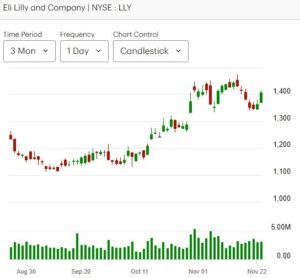
Eton Pharmaceuticals also attracted attention.
The strength in these individual stocks is noteworthy because it occurred during a session when technology shares and several major growth-oriented sectors were under pressure.
Traders should continue monitoring healthcare stocks for emerging leadership and potential opportunities, particularly those demonstrating relative strength against the broader market.
Retail Stocks: Earnings Create Opportunities
Retail stocks also provided some interesting developments.
SharkNinja (SN), Dollar Tree (DLTR) and Abercrombie & Fitch (ANF) surged following their earnings reports, attracting buying interest from investors.
Meanwhile, Walmart (WMT) and Target (TGT) were reported to be displaying potentially constructive technical buy signals.
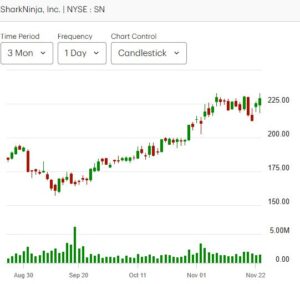
The retail sector’s mixed performance highlights the importance of individual company fundamentals and earnings results in determining stock performance.
For traders, earnings-driven price movements can create opportunities, but it is important to distinguish between an initial positive reaction and a sustained improvement in a stock’s technical condition.
Key Takeaways for Traders and Investors
1. The technology sector remains a significant source of market uncertainty.
The Nasdaq declined 1.48%, while semiconductor and technology-related stocks experienced renewed selling pressure. Traders should monitor Nvidia and other major semiconductor companies for signs of stabilization before assuming that the recent weakness has ended.
2. The major indexes are showing divergent performance.
The Dow Jones and Russell 2000 advanced, while the S&P 500 and Nasdaq declined. This divergence indicates that the market recovery remains uneven and that investors are becoming more selective.
3. Market internals offer a mixed picture.
The NYSE demonstrated some improvement, with positive market breadth and a better new-high-to-new-low ratio. However, the Nasdaq finished with negative market breadth, and new 52-week lows continued to outnumber new highs substantially.
This divergence suggests that the broader market has not yet achieved a convincing improvement in underlying conditions.
4. Healthcare stocks are demonstrating relative strength.
Sanofi, Insmed, Regeneron, Eli Lilly, Gilead Sciences, and other healthcare-related companies attracted buying interest. Traders should watch for individual stocks demonstrating sustained relative strength and constructive technical patterns.
5. The Russell 2000’s technical condition remains concerning.
Despite Tuesday’s advance, the small-cap index remains below its three key moving averages. Its recent Death Cross is an additional warning sign. Traders should be cautious about interpreting a single positive session as confirmation of a broader recovery.
6. Pay attention to sector rotation and emerging market leaders.
When the broader market becomes uncertain, some individual stocks can continue to outperform. Traders should identify stocks demonstrating relative strength, improving volume characteristics, positive earnings developments, and sustained upward price momentum.
Building a watchlist of emerging leaders can help investors prepare for opportunities when broader market conditions improve.
7. Risk management remains essential.
The objective of trading is to make money while minimizing losses. In a volatile market, traders should avoid chasing sharp price movements, exercise discipline with position sizing, and remain prepared to protect capital when market conditions deteriorate.
Overall US Market Assessment
Tuesday’s trading session demonstrated that the US stock market remains volatile and that Monday’s strong rebound has not yet translated into a sustainable recovery.
Although the Dow Jones and Russell 2000 advanced, the S&P 500 and Nasdaq declined. The Nasdaq’s substantial loss was particularly concerning, reflecting renewed weakness in technology and semiconductor stocks.
Market internals also presented a mixed picture. The NYSE showed some encouraging improvements, but the Nasdaq continued to struggle with negative market breadth and a substantial imbalance between new 52-week highs and new lows.
On a more positive note, healthcare stocks demonstrated considerable strength, while selected retail and consumer-related companies attracted buying interest.
The market is therefore presenting a combination of opportunities and risks. Investors should not assume that every sector will move in the same direction, nor should they assume that a strong performance in one trading session represents the beginning of a lasting bullish trend.
For the time being, traders and investors should remain selective, monitor sector rotation, and pay close attention to emerging market leaders.
The bottom line: The US market is struggling to establish a consistent bullish direction. Technology and semiconductor weakness remain significant obstacles, while healthcare and selected individual stocks are showing encouraging relative strength. Until market breadth improves more consistently and the major indexes reclaim their important technical levels, a cautious and selective trading approach remains appropriate.
.
NOTICE TO READERS
The Canadian Vanguard Stock Market is about empowering you to build and manage your wealth by yourself. There is certainly no magic in managing finances or wealth but one needs to know what to do and commit to doing what is needed. When you are ready to start the journey to Take Charge and Put Your Destiny In Your Own Hands, start with reading The Canadian Vanguard every market day. If and when you need more related information or to advertise your business products or services in The Canadian Vanguard, Contact Us
Our readers are strongly advised to conduct their own research into individual stocks before making a purchase decision. In addition, investors are advised that past stock performance is no guarantee of future price appreciation. Any recommendation is not a guarantee of any particular stock’s future prices, and The Canadian Vanguard accepts no responsibility or liability for investors’ or readers’ purchases.
The dollar sign “$” in the Toronto Market section in the articles only stands for Canadian dollar and in the US market section “$” stands for US dollar.
(c) This article is published by The Canadian Vanguard on November 24, 2026