







Markets Slide as Stronger U.S. Dollar and Rate Hike Concerns Weigh on Investors
The Canadian Vanguard Stock Market Report Wednesday June 17, 2026 Edition
.
The Toronto Market
Wednesday’s Toronto Market Index
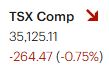
The S&P/TSX Composite Index declined 264.47 points, or 0.75%, to close at 35,125.11 on Wednesday. The index came under selling pressure as U.S. markets weakened following the scheduled post-meeting press conference by the Chair of the U.S. Federal Reserve’s Federal Open Market Committee (FOMC). The conference began at 2:00 p.m. after the conclusion of the FOMC’s two-day policy meeting, which typically starts on Tuesday.
The TSX moved lower in tandem with major U.S. market indexes, reflecting the strong correlation between Canadian and U.S. equity markets. The day’s performance highlighted the significant influence that developments in U.S. financial markets continue to have on the Toronto market.


Wednesday’s TSX Market Statistics
Market breadth on the TSX was negative on Wednesday, with declining issues significantly outnumbering advancing issues. There were 1,476 declining stocks compared with 785 advancing stocks, resulting in a decliner-to-advancer ratio of 1.88-to-1, or nearly two decliners for every advancer. An additional 145 issues closed unchanged.
The exchange recorded 323 new 52-week highs and 29 new 52-week lows, compared with 311 new highs and 15 new lows on the previous trading day. Notably, the number of new 52-week highs has increased over each of the last two trading sessions, indicating continued strength among a segment of listed securities despite the broader market decline.
Total trading volume on the TSX reached 524.8 million shares, representing an increase of approximately 8% from the 485.1 million shares traded on Tuesday. The combination of a higher volume and a predominance of declining issues underscored the market’s negative tone during the session.
Wednesday’s Toronto Market Wrap-Up Report
The Toronto market closed lower on Wednesday as investors reacted to weakness in U.S. equities following the Federal Reserve’s post-FOMC meeting press conference. The S&P/TSX Composite Index declined 264.47 points, or 0.75%, to close at 35,125.11. The session once again highlighted the strong correlation between Canadian and U.S. markets, with selling pressure intensifying during the afternoon as U.S. indexes moved lower.
Market participation was broadly negative. Declining issues outnumbered advancing issues by 1,476 to 785, producing a decliner-to-advancer ratio of 1.88-to-1. Total trading volume reached 524.8 million shares, up 8% from the previous session, indicating increased selling activity. Despite the broad market weakness, the TSX recorded 323 new 52-week highs, up from 311 the previous day, while new 52-week lows increased to 29 from 15.
Sector Performance
Only two of the TSX’s ten major sectors finished the session in positive territory:
- Financials: +0.51%
- Consumer Discretionary: +0.50%
The weakest-performing sectors were:
- Technology: -2.48%
- Industrials: -1.78%
- Basic Materials: -1.75%
The broad-based decline across most sectors reflected a risk-off tone among investors, particularly in growth-oriented and cyclical stocks.
Financials Lead the Market
The Financials sector outperformed as five of Canada’s six major banks posted gains.
- Bank of Nova Scotia: +1.83%
- National Bank of Canada: +1.70%
- Toronto-Dominion Bank: +1.20%
- Bank of Montreal: +1.08%
- Royal Bank of Canada: +0.61%
- Canadian Imperial Bank of Commerce: -0.39%
The strength in the banking sector helped cushion some of the broader market weakness and provided support for the TSX throughout much of the session.
Retail and Consumer Stocks Show Strength
Consumer-related stocks were among the day’s strongest performers, mirroring similar strength seen in U.S. retail names.
Gildan Activewear Inc. (GIL) gained 6.52% on volume of 2.52 million shares, making it one of the notable outperformers on the TSX. The stock’s strong advance reflected continued investor interest in consumer and apparel-related companies despite broader market uncertainty.
Space Infrastructure Stocks Rebound
Space infrastructure companies staged a notable rebound after recent competitive concerns surrounding U.S.-based Space Exploration Technologies Corp. (SPCX). Following strong investor enthusiasm surrounding SPCX stock in recent sessions, the stock declined 5% on Wednesday, creating an opportunity for investors to revisit established players in the sector.
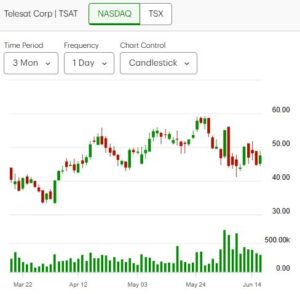
Telesat Corporation (TSAT) rose 6.29% on volume of 48,000 shares, while MDA Space Ltd. (MDA) advanced 4.51% on volume of 1.37 million shares. The gains suggest investors continue to see value in established satellite and space infrastructure companies despite increasing competition within the industry.
Takeaway for Traders and Investors
Wednesday’s market action reflected a cautious investor mood driven largely by developments in the United States. While the TSX experienced broad-based selling pressure, strength in Financials and Consumer Discretionary stocks helped moderate losses. The negative market breadth and higher trading volume confirmed that sellers were in control during the session. However, the continued increase in new 52-week highs suggests that pockets of leadership remain intact beneath the surface.
For traders, the key message is that market sentiment remains highly sensitive to U.S. monetary policy developments. For investors, the resilience shown by Financials and selected growth themes, such as space infrastructure and consumer-related stocks, may provide clues as to where institutional money continues to find opportunities despite a weaker overall market environment.
.
The US Markets
Wednesday’s U.S. Market Indexes
U.S. equity markets closed sharply lower on Wednesday as investors reacted negatively to comments made during the Federal Reserve Chair’s post-FOMC meeting press conference.
The Dow Jones Industrial Average fell 507.12 points, or 0.98%, to close at 51,492.55. The S&P 500 declined 91.25 points, or 1.21%, ending the session at 7,420.10. The Nasdaq Composite led the major indexes lower, dropping 354.69 points, or 1.34%, to finish at 26,021.66. The small-cap Russell 2000 Index lost 21.21 points, or 0.72%, closing at 2,917.98.
All four major U.S. equity indexes ended the session in negative territory.

Earlier in the day, both the Dow Jones Industrial Average and the Russell 2000 traded comfortably above their previous closing levels and appeared positioned to extend their gains. However, market sentiment shifted abruptly following the Federal Reserve Chair’s remarks during the scheduled post-FOMC press conference.
Investors focused on the Federal Reserve’s continued commitment to maintaining price stability and controlling inflation. While the central bank’s comments did not provide a definitive roadmap for future policy actions, market participants interpreted the remarks as signaling that interest rates could remain elevated for longer than previously anticipated, with the possibility of additional policy tightening if inflationary pressures persist.
The U.S. dollar strengthened following the announcement, while Treasury yields moved higher as investors reassessed interest-rate expectations. Higher interest rates generally increase borrowing costs for businesses and consumers and can reduce the present value of future corporate earnings, creating headwinds for equity valuations, particularly in growth-oriented sectors.
Stocks initially attempted to recover from the post-announcement selloff, but buying interest proved insufficient. Selling pressure intensified during the afternoon session, resulting in a broad-based decline that persisted into the market close.
Market Takeaway
Wednesday’s trading session highlighted the market’s continued sensitivity to Federal Reserve policy and interest-rate expectations. Although economic growth remains relatively resilient, investors remain cautious about the potential impact of higher-for-longer interest rates on corporate earnings, consumer spending, and overall market valuations.
For traders, the sharp reversal from intraday gains to broad-based losses underscores the importance of monitoring Federal Reserve communications and interest-rate expectations as key drivers of short-term market sentiment. For longer-term investors, the session serves as a reminder that monetary policy remains one of the most influential factors shaping market direction and sector performance.
Wednesday’s U.S. Market Statistics
New York Stock Exchange (NYSE): Market breadth on the NYSE was decisively negative on Wednesday, with declining issues significantly outnumbering advancing issues. The exchange recorded 3,277 declining stocks compared with 1,249 advancing stocks, while 454 issues closed unchanged. This resulted in a decliner-to-advancer ratio of approximately 2.62-to-1, meaning that nearly five stocks declined for every two stocks that advanced.
The NYSE posted 282 new 52-week highs and 131 new 52-week lows, compared with 338 new highs and 84 new lows recorded during the previous session. The decline in new highs and increase in new lows suggest that market leadership weakened as selling pressure intensified throughout the day.
Total NYSE trading volume reached 6.01 billion shares, an increase of approximately 11% from the 5.40 billion shares traded on Tuesday. The combination of heavier trading volume and negative market breadth indicates that institutional selling activity increased following the Federal Reserve’s post-FOMC press conference.
NASDAQ: Market breadth on the NASDAQ was also negative, although somewhat less severe than on the NYSE. Declining issues totaled 3,131, compared with 1,778 advancing issues, resulting in a decliner-to-advancer ratio of 1.76-to-1. An additional 348 securities closed unchanged.
Selling pressure accelerated during the afternoon following the Federal Reserve Chair’s press conference, erasing earlier gains and pushing major technology and growth-oriented stocks lower. The broad-based selling contributed significantly to the Nasdaq Composite’s decline and reinforced the risk-off sentiment that emerged across U.S. equity markets.
The exchange recorded 164 new 52-week highs and 152 new 52-week lows, compared with 182 new highs and 142 new lows during the previous session. The narrowing gap between new highs and new lows suggests that market leadership among growth stocks is becoming less robust, a trend that traders should continue to monitor.
Total NASDAQ trading volume reached 12.12 billion shares, up 3% from Tuesday’s volume of 11.74 billion shares.
While the Nasdaq experienced a significant decline, the relatively modest increase in trading volume does not indicate panic selling. Instead, the session appears to reflect a measured reassessment of risk following the Federal Reserve’s comments rather than widespread liquidation by investors. Typically, major market tops and panic-driven declines are accompanied by substantially larger volume spikes than those observed during Wednesday’s session.
Technical Perspective
From a technical standpoint, the Nasdaq Composite is now trading near its 50-day moving average, an important intermediate-term support level closely watched by traders and institutional investors. A successful rebound from this area would help preserve the index’s longer-term uptrend and could restore investor confidence in the technology sector.
Conversely, a decisive break below the 50-day moving average, particularly if accompanied by expanding volume and deteriorating market breadth, could signal the beginning of a deeper correction. As a result, the Nasdaq’s behavior over the next several trading sessions may provide important clues regarding the market’s near-term direction.
Market Takeaway
Wednesday’s market statistics paint a picture of broad-based weakness rather than outright panic. Both the NYSE and NASDAQ experienced negative breadth, rising trading volume, and a deterioration in new-high/new-low data following the Federal Reserve’s policy communications.
For traders, the key development is the market’s reaction to interest-rate expectations rather than the policy announcement itself. For investors, the absence of panic-driven volume suggests that the longer-term bullish trend has not necessarily been compromised, but continued monitoring of market breadth, volume trends, and key technical support levels—particularly on the Nasdaq—will be critical in assessing whether the current pullback remains a healthy correction or evolves into something more significant.
Wednesday’s U.S. Market Wrap-Up Report
U.S. equities closed sharply lower on Wednesday as investors reacted to the Federal Reserve’s latest policy decision and the subsequent remarks by the Fed Chair during the post-FOMC press conference.
As widely expected, the Federal Reserve left its benchmark interest rate unchanged. However, policymakers indicated that inflation remains a concern and signaled that additional policy tightening could still be possible should inflationary pressures persist. The Fed Chair reiterated the central bank’s commitment to maintaining price stability, prompting investors to reassess interest-rate expectations and risk exposure.
The market’s reaction was swift. The U.S. dollar strengthened following the announcement, while equities sold off throughout the afternoon. Major indexes, which had traded higher earlier in the session, reversed course shortly after the Fed Chair’s press conference began at 2:00 p.m. Selling pressure intensified into the closing bell.
Major Index Performance
All major U.S. equity indexes finished the session lower:
- Dow Jones Industrial Average: -507.12 points (-0.98%) to 51,492.55
- S&P 500: -91.25 points (-1.21%) to 7,420.10
- Nasdaq Composite: -354.69 points (-1.34%) to 26,021.66
- Russell 2000: -21.21 points (-0.72%) to 2,917.98
The Nasdaq Composite led the decline as investors reduced exposure to growth-oriented and technology stocks, which tend to be more sensitive to interest-rate expectations.
Sector Performance
The selloff was broad-based, with all eleven major S&P sectors closing in negative territory.
The best-performing sectors were:
- Utilities: -0.19%
- Financials: -0.50%
- Technology: -0.89%
The weakest sectors were:
- Consumer Discretionary (Durable Consumer Goods & Services): -2.40%
- Basic Materials: -1.76%
- Energy: -1.28%
The relative strength in Utilities and Financials reflected a defensive rotation as investors sought stability amid rising uncertainty surrounding future monetary policy.
Market Breadth and Volume
Market internals confirmed the broad nature of the decline.
New York Stock Exchange (NYSE): Declining issues outnumbered advancing issues by 3,277 to 1,249, resulting in a decliner-to-advancer ratio of approximately 2.62-to-1. Total trading volume rose 11% to 6.01 billion shares.
The NYSE recorded 282 new 52-week highs and 131 new 52-week lows, compared with 338 highs and 84 lows during the previous session, indicating a noticeable deterioration in market leadership.
NASDAQ: NASDAQ breadth was also negative, with 3,131 declining stocks versus 1,778 advancing stocks, resulting in a decliner-to-advancer ratio of 1.76-to-1. Trading volume increased modestly by 3% to 12.12 billion shares.
Although the Nasdaq experienced a significant decline, volume levels did not suggest panic selling. Instead, the session appeared to reflect a disciplined reassessment of risk by institutional investors following the Fed’s comments.
From a technical perspective, the Nasdaq Composite is now testing its 50-day moving average, a key support level that traders will be closely monitoring in the days ahead.
Notable Corporate Movers
While technology stocks generally weakened, several individual names delivered strong gains.
Among the day’s standout performers:
- Robinhood Markets Inc. (HOOD): +8.78%
- GE Vernova Inc. (GEV): +6.77% to $1,048.86 on volume of 4.0 million shares
- Moderna Inc. (MRNA): +6.40%
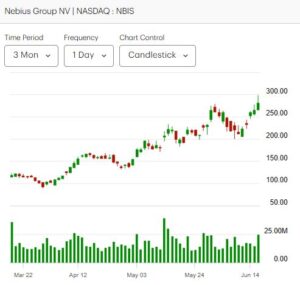
- Nebius Group (NBIS): +5.96% to $280.91 on volume of 24.3 million shares
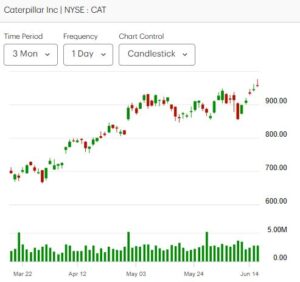
- Caterpillar Inc. (CAT): +1.10% to $955.92 on volume of 2.73 million shares
Meanwhile, recently public Space Exploration Technologies Corp. (SPCX), one of the market’s strongest performers over the past week, declined 5% as investors took profits following its post-listing rally.
Geopolitical Development
Following the market close, reports emerged that U.S. President Donald Trump and Iranian President Masoud Pezeshkian had digitally signed a memorandum of understanding aimed at establishing a framework for a permanent peace agreement between their nations.
If confirmed and supported by subsequent diplomatic actions, the development could improve investor sentiment by reducing geopolitical uncertainty and easing concerns surrounding global energy markets. Equity futures responded positively during evening trading, suggesting investors viewed the news favorably.
Market Takeaway
Wednesday’s session demonstrated that monetary policy remains the dominant driver of market sentiment. Investors entered the day optimistic, but concerns about the possibility of higher-for-longer interest rates quickly shifted the market into risk-off mode following the Federal Reserve’s communications.
The combination of broad-based sector declines, negative market breadth, and higher trading volume confirms that sellers controlled the session. However, the absence of panic-level volume suggests the move was more of a repricing of expectations than a wholesale exit from equities.
For traders, the key focus will be whether the Nasdaq can successfully defend its 50-day moving average and whether market breadth stabilizes over the coming sessions. For investors, the resilience of defensive sectors and select growth leaders suggests that capital remains active in the market, even as participants navigate an uncertain interest-rate environment.
Looking ahead, traders will be watching incoming inflation data, Treasury yields, and Federal Reserve commentary for clues about the next direction of monetary policy. Any improvement in geopolitical conditions could also provide a supportive backdrop for risk assets as markets head into Thursday’s session.
.
NOTICE TO READERS
The Canadian Vanguard Stock Market is about empowering you to build and manage your wealth by yourself. There is certainly no magic in managing finances or wealth but one needs to know what to do and commit to doing what is needed. When you are ready to start the journey to Take Charge and Put Your Destiny In Your Own Hands, read The Canadian Vanguard every market day. If you need more related information, Contact Us
Our readers are strongly advised to conduct their own research into individual stocks before making a purchase decision. In addition, investors are advised that past stock performance is no guarantee of future price appreciation. Any recommendation is not a guarantee of any particular stock’s future prices, and The Canadian Vanguard accepts no responsibility or liability for investors’ or readers’ purchases.
Stocks In The News/ Stocks To Watch and Market Strategy will soon be available only to Paying Subscribers. The dollar sign “$” in the Toronto Market section in the articles only stands for Canadian dollar and in the US market section “$” stands for US dollar.
(c) This article is published by The Canadian Vanguard on June 17, 2026