







Markets Undergo an Orderly Pullback as Investors Lock In Profits
The Canadian Vanguard Stock Market Report Wednesday June 3, 2026 Edition
.
The Toronto Market
Wednesday’s Toronto Market Index
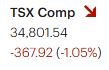
The Toronto S&P/TSX Composite Index fell 367.92 points, or 1.05%, to close at 34,801.54.
The TSX declined on Wednesday as investors took profits following Tuesday’s strong rally. Market sentiment was also tempered by rising oil prices and ongoing uncertainty surrounding U.S.-Iran peace talks. After reaching record territory in the previous session, the index appeared vulnerable to profit-taking as investors sought to lock in gains rather than risk having them eroded by potential market volatility and geopolitical developments.
Trading activity was relatively subdued, with total share volume declining by 5% compared with the previous day.
Wednesday’s TSX Market Statistics
On the TSX, declining issues (decliners) outnumbered advancing issues (advancers). Specifically, there were 1,493 decliners and 646 advancers, resulting in a decliner-to-advancer ratio of 2.31-to-1, or approximately two decliners for every advancer. An additional 170 issues closed unchanged. As a result, market breadth was negative.
The exchange recorded 211 new 52-week highs and 50 new 52-week lows, compared with 352 new highs and 43 new lows reported the previous day.
Total trading volume on the TSX reached 461,487,558 shares, down 5% from the 487,007,267 shares traded yesterday. Although the index declined, the lower trading volume suggests that the pullback was relatively orderly and driven primarily by profit-taking rather than panic selling. Investors appeared more inclined to lock in gains than to bid prices higher, which also contributed to the sharp decline in the number of new 52-week highs compared with the previous session.
Wednesday’s Toronto Market Wrap-Up
The Toronto market’s rebound proved short-lived, as the S&P/TSX Composite Index retreated sharply on Wednesday following Tuesday’s record close. The pullback mirrored weakness across North American equity markets, where investors locked in profits after several consecutive sessions of gains while weighing geopolitical uncertainties and rising oil prices.
Market internals reflected broad-based weakness. Declining stocks significantly outnumbered advancing issues, confirming negative market breadth and signaling widespread selling pressure across the exchange. However, trading volume was 5% lower than the previous session, suggesting that the decline was largely driven by profit-taking rather than panic selling.
Sector performance was mixed. Consumer Durables & Apparel led the market with a gain of 1.63%, while Energy advanced 0.72% as higher crude oil prices continued to support the sector. Financials slipped 0.61%, while growth-oriented sectors bore the brunt of the selling. Technology declined 3.28%, and Basic Materials fell 3.29%, making it the session’s weakest-performing sector.
Among Canada’s major banks, Royal Bank of Canada (RY) was the sole member of the Big Six to finish in positive territory, gaining 0.47% on volume of 2.25 million shares. The relative strength in Royal Bank suggests investors continue to favor high-quality financial franchises during periods of market consolidation.
In company-specific trading, VersaBank (VBNK) was a standout performer, surging 9.33% on volume of 124,000 shares. Precision Drilling Corp. (PD) gained 2.39%, benefiting from strength in the energy complex, although volume remained relatively light at 69,000 shares. Aritzia Inc. (ATZ) continued its impressive run, advancing 1.36% to close at $160.34 on 344,000 shares traded.
Technology names weighed heavily on the index. Celestica Inc. (CLS) fell 2.57% to $636.06 on volume of 349,600 shares, while Shopify Inc. (SHOP) declined 3.01% to $157.08 with nearly 2 million shares changing hands. In the materials sector, Cameco Corp. (CCO) experienced notable profit-taking, dropping $7.34, or 4.40%, on volume of 1.06 million shares.
The decline in both technology and materials stocks was particularly significant given their strong leadership roles during the recent market advance. Wednesday’s weakness suggests investors may be rotating capital away from higher-beta sectors after an extended rally and reassessing risk exposure near all-time highs.
Takeaway for Traders and Investors
Wednesday’s pullback appears more consistent with a healthy consolidation than the beginning of a major market correction. Lower trading volume, continued strength in selected defensive and energy-related names, and the absence of panic selling indicate that investors are primarily taking profits after the market’s recent run to record levels.
For traders, the key question is whether the TSX can hold above recent breakout levels and attract renewed buying interest. For investors, sector rotation remains the dominant theme, with capital moving away from some of the market’s strongest performers and toward areas perceived as offering better risk-adjusted value. Monitoring market breadth, volume trends, and leadership among financials, energy, and technology stocks will provide important clues regarding the market’s next directional move.
.
The US Markets
Wednesday’s U.S. Market Indexes
U.S. equity markets retreated on Wednesday as investors engaged in profit-taking following the recent advance that pushed major indexes toward record territory. Despite the broad-based decline, market action remained orderly, with no signs of widespread panic selling.
The Dow Jones Industrial Average fell 620.72 points, or 1.21%, to close at 50,687.07. The S&P 500 declined 56.10 points, or 0.74%, ending the session at 7,553.68. The Nasdaq Composite lost 239.93 points, or 0.89%, finishing at 26,853.98, while the Russell 2000 Index dropped 38.45 points, or 1.31%, to close at 2,893.51.
Small-cap stocks experienced the heaviest selling pressure as rising Treasury yields reduced investor appetite for higher-risk equities. The Russell 2000’s underperformance suggests that market participants became more selective in their risk exposure, favoring larger, more established companies over smaller-cap growth opportunities.
The Dow and Russell 2000 were particularly weak throughout the session. Both indexes opened in negative territory and remained under pressure from the opening bell to the close, reflecting persistent selling interest rather than a late-session reversal. The Dow’s decline of more than 1.2% and the Russell 2000’s drop of more than 1.3% highlighted the breadth of the pullback across both large-cap and small-cap segments of the market.
While Wednesday’s session was clearly negative, the major indexes remain relatively close to their recent record highs. The absence of heavy-volume liquidation and the market’s ability to hold well above key support levels suggest that this move should currently be viewed as a normal pullback within an ongoing bullish trend rather than the beginning of a more significant correction.
Market Takeaway
For traders, Wednesday’s decline serves as a reminder that markets rarely move higher in a straight line. After a strong rally, some degree of profit-taking was inevitable, particularly with Treasury yields moving higher and valuations becoming more stretched.
For investors, the key message is that the broader uptrend remains intact despite the day’s weakness. Market leadership may continue to rotate as investors adjust portfolios in response to interest-rate expectations and changing risk conditions. Attention should now shift to whether buyers return on subsequent pullbacks and whether major indexes can maintain support levels near recent breakout areas.
Until evidence suggests otherwise, Wednesday’s decline appears to be a healthy consolidation within a market that remains near historically elevated levels.

.
Wednesday’s U.S. Market Statistics
New York Stock Exchange (NYSE): Market breadth was decisively negative on the NYSE, with declining issues substantially outnumbering advancing issues. There were 3,422 decliners compared with 1,127 advancers, while 388 issues closed unchanged. This produced a decliner-to-advancer ratio of approximately 3.03-to-1, meaning that roughly three stocks declined for every stock that advanced.
The exchange recorded 291 new 52-week highs and 187 new 52-week lows, compared with 571 new highs and 139 new lows reported in the previous session. The sharp decline in new highs suggests that bullish momentum cooled considerably following the market’s recent advance.
Total NYSE trading volume reached 5.90 billion shares, down 2.5% from 6.05 billion shares traded yesterday. The combination of lower volume and a broad market decline suggests that Wednesday’s weakness was driven more by profit-taking and portfolio repositioning than by aggressive institutional selling.
NASDAQ: Market breadth was similarly negative on the NASDAQ. Declining stocks outnumbered advancing stocks by a wide margin, with 3,591 decliners and 1,352 advancers, while 313 issues finished unchanged. This resulted in a decliner-to-advancer ratio of approximately 2.65-to-1, indicating that nearly three stocks declined for every stock that advanced.
The NASDAQ recorded 242 new 52-week highs and 211 new 52-week lows, compared with 412 new highs and 147 new lows in the previous session. The decline in new highs combined with an increase in new lows reflects weakening participation among growth and momentum stocks.
Trading volume on the NASDAQ totaled 9.77 billion shares, down 2.5% from 10.08 billion shares traded yesterday. As on the NYSE, lower volume during a broad market pullback points to an orderly retreat rather than widespread liquidation.
Market Breadth Takeaway
Wednesday’s market internals confirmed the weakness seen in the major indexes. Both the NYSE and NASDAQ experienced strongly negative breadth, with decliners outnumbering advancers by better than two-to-one. However, the decline occurred on lighter volume and while the number of new 52-week highs remained comfortably above new lows on both exchanges.
For traders, the deterioration in breadth is a signal that market momentum has weakened in the short term. For investors, the data suggest that the market is undergoing a broad but orderly consolidation following a strong rally. Unless selling pressure intensifies and begins to occur on rising volume, the current pullback appears more consistent with profit-taking than the start of a significant trend reversal.
.
Wednesday’s U.S. Market Wrap-Up Report
U.S. equity markets retreated Wednesday as investors took profits following an extended rally that had pushed major indexes toward record territory. While the pullback was broad-based, small-cap stocks experienced the heaviest selling pressure as rising Treasury yields prompted investors to reduce exposure to more interest-rate-sensitive segments of the market.
Despite the negative session, the decline appeared orderly rather than driven by panic selling. After several consecutive sessions of gains—including a nine-session winning streak for the S&P 500—a period of consolidation was not unexpected. Market participants used the strength of recent weeks as an opportunity to lock in profits while reassessing valuations in light of higher bond yields and rising energy prices.
Sector performance reflected a defensive tone. Only three of the eleven S&P sectors finished in positive territory. Energy led the market with a gain of 0.68%, supported by higher crude oil prices. Healthcare advanced 0.66%, while Consumer Durables & Services added 0.52%.
On the downside, economically sensitive and growth-oriented sectors underperformed. Financials declined 1.29%, Technology fell 1.34%, and Basic Materials dropped 1.65%. Communication Services was the weakest sector of the day, sliding 2.95% as investors reduced exposure to several high-growth names.
The market’s weakness was largely attributed to rising Treasury yields and higher oil prices. The benchmark 10-year Treasury yield climbed to 4.483%, increasing borrowing costs across the economy and reducing the relative attractiveness of risk assets. Small-cap companies, which often rely more heavily on external financing to fund growth, were particularly vulnerable to the rise in yields, helping explain the Russell 2000’s underperformance.
Commodities and Fixed Income
Commodity markets were mixed. Brent crude oil futures rose 2.25%, reflecting ongoing supply concerns and geopolitical uncertainty. Gold futures declined 0.65% as higher Treasury yields weighed on the precious metal. Bitcoin was little changed, rising 0.08% to $67,250. Meanwhile, the rise in Treasury yields remained a focal point for equity investors as bond markets continued to influence risk sentiment.
Company Highlights
Technology and AI infrastructure-related stocks faced profit-taking after their strong recent advances.
IBM experienced one of the day’s sharpest declines, falling 7.17%. The stock had rallied in the previous session following reports that the U.S. government would support domestic quantum computing research and that IBM would play a leading role in the initiative. Wednesday’s decline appeared to be driven primarily by profit-taking following that surge.
Within the AI infrastructure segment, Celestica fell 3.02%, Dell Technologies declined 3.27%, and Hewlett Packard Enterprise (HPE) lost 1.78%. The pullback in these names reflects investors harvesting gains after a prolonged period of outperformance rather than a fundamental deterioration in the sector’s outlook.
One notable exception was Marvell Technology, which continued to attract strong buying interest. Marvell gained 3.73% to close at $301.65 on exceptionally heavy volume of 115 million shares, highlighting ongoing investor demand for select AI and semiconductor-related opportunities.
Takeaway for Traders and Investors
Wednesday’s decline should currently be viewed as a healthy correction within a broader bullish trend rather than the beginning of a significant market downturn. Market breadth was weak, but selling occurred on relatively lighter volume, suggesting an orderly pullback rather than institutional liquidation.
For traders, rising Treasury yields remain the key variable to watch. Continued upward pressure on yields could weigh further on small-cap, technology, and other growth-oriented sectors. For investors, sector rotation appears to be underway, with capital flowing toward energy and defensive areas while profit-taking emerges in some of the market’s strongest performers.
The most important question heading into the next session is whether buyers step in near recent support levels. If they do, Wednesday’s pullback may ultimately be remembered as a routine pause within an ongoing uptrend. If selling pressure broadens and volume expands, traders may need to prepare for a deeper period of consolidation.
.
IMPORTANT NOTICE TO READERS
The Canadian Vanguard Stock Market’s focus is on empowering our readers to build and manage wealth by themselves. There is certainly no magic in managing finances or wealth but one needs to know what to do and commit to doing what is needed. When you are ready to start the journey to Take Charge and Put Your Destiny In Your Own Hands, read The Canadian Vanguard every market day. Stock market investing is a lot cheaper to get into, more liquid and easier than real estate investing.
Our readers are strongly advised to conduct their own research into individual stocks before making a purchase decision. In addition, investors are advised that past stock performance is no guarantee of future price appreciation. Any recommendation is not a guarantee of any particular stock’s future prices, and The Canadian Vanguard accepts no responsibility or liability for investors’ or readers’ purchases.
Stock Market Wrap Up Report and Market Strategy sections will be available from now on only to Paying Subscribers. The dollar sign “$” in the Toronto Market section in the articles only stands for Canadian dollar and in the US market section “$” stands for US dollar.
(c) This article is published by The Canadian Vanguard on June 3, 2026