







TSX Roars Back as Small- and Large-Cap Stocks Propel U.S. Indexes to Record Highs
The Canadian Vanguard Stock Market Report Tuesday June 2, 2026 Edition
.
The Toronto Market
Tuesday’s Toronto Market Index
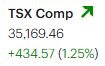
The S&P/TSX Composite Index gained 434.57 points (1.25%) on Tuesday, closing at a record 35,169.46. The strong rally helped offset some of the losses recorded over the past week, particularly Monday’s sharp decline, when the index fell significantly during the early trading session.
Tuesday’s advance pushed the TSX above the 35,000 level for the first time, marking a new all-time closing high. Trading volume was close to the 50-day average, suggesting broad market participation and support for the index’s strong performance.


Tuesday’s TSX Market Statistics
Market breadth was firmly positive on Tuesday, with advancing issues significantly outnumbering declining issues. A total of 1,448 stocks advanced while 771 declined, resulting in an advancer-to-decliner ratio of 1.87:1—nearly two advancing stocks for every declining stock. An additional 150 issues closed unchanged.
The TSX recorded 352 new 52-week highs and 43 new 52-week lows, compared with 276 new highs and 34 new lows on Friday. The increase in new highs reflects continued strength across a broad range of stocks.
Total trading volume reached 487.0 million shares, down just 1% from the 493.1 million shares traded in the previous session. Trading activity in both sessions was close to the 50-day average volume, suggesting a normal level of market participation. This contrasts with much of early last week, when trading volumes frequently exceeded the 50-day average. The return to more typical volume levels may indicate that market conditions are becoming more stable following last week’s heightened volatility
Tuesday’s Toronto Market Wrap-Up Report
The Toronto market staged a strong rebound on Tuesday, with the S&P/TSX Composite Index advancing 434.57 points, or 1.25%, to close at a record 35,169.46. The rally helped recover a portion of last week’s losses, particularly following Monday’s sharp decline. The TSX also achieved a historic milestone by closing above the 35,000 level for the first time.
Market participation supported the advance. Advancing stocks outnumbered declining stocks by nearly two to one, with 1,448 advancers versus 771 decliners, while 150 issues were unchanged. The exchange also recorded 352 new 52-week highs compared with only 43 new lows, underscoring the broad-based strength of the rally.
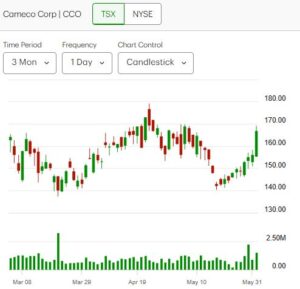
Leadership came from several sectors and industries. Among the strongest individual performers were 5N Plus Inc., which gained 9.46%, Cameco Corporation, up 7.07%, and Energy Fuels Inc., which advanced 10.89%. The Materials sector was particularly well represented among the day’s leaders, with Seabridge Gold Inc. rising 6.71%, First Quantum Minerals gaining 6.00%, and Franco-Nevada Corporation adding 3.30%. The figure below shows Cameco Corp 3months, daily chart, in a “sort of rough” double bottom pattern.
Six of the TSX’s ten major sectors finished higher. Energy led the market with a gain of 2.33%, followed by Basic Materials, up 2.07%, and Financials, up 1.51%. Consumer Discretionary rose 0.91%, Industrials advanced 0.84%, and Utilities added 0.37%. In contrast, Technology reversed course after Monday’s strong performance and declined 3.99%.
Canada’s major financial institutions contributed positively to the market’s advance. Toronto-Dominion Bank rose 2.17% on trading volume of 2.89 million shares, while Royal Bank of Canada gained 1.33% on 3.03 million shares traded. Manulife Financial Corporation advanced 1.78% on volume of 9.22 million shares. Bank of Montreal gained 1.63% and recorded a new 52-week high, reflecting continued strength within the financial sector.
Despite the sector’s overall weakness, Celestica Inc. delivered the strongest individual performance on the TSX. The stock surged 10.98% to close at $652.82 on volume of 588,000 shares. Celestica has now posted gains in three consecutive trading sessions and remains one of the market’s strongest momentum names.
Trading volume on the TSX totaled 487.0 million shares, essentially unchanged from Monday’s 493.1 million shares and close to the exchange’s 50-day average. Unlike the elevated trading activity seen during much of early last week, current volume levels suggest a return to more normal market conditions. The combination of record index levels, positive market breadth, expanding new highs, and stable trading volume points to a healthier and more sustainable advance than one driven solely by a handful of large-cap stocks.
Takeaways for Investors and Traders
For Investors:
- The TSX’s record close above 35,000, combined with strong market breadth and a rising number of 52-week highs, suggests underlying market strength remains intact.
- Leadership from Energy, Materials, and Financials indicates that cyclical sectors continue to attract capital.
- The broad participation in Tuesday’s rally may be a constructive signal for medium-term market sentiment.
For Traders:
- Momentum remains strongest in select Energy, Materials, and Technology names, with Celestica continuing to demonstrate exceptional relative strength.
- The nearly 2:1 advancer-to-decliner ratio and surge in new highs support a bullish near-term trading backdrop.
- Watch whether the TSX can hold above the psychologically important 35,000 level. Sustained trading above this level would reinforce the current uptrend, while a failure to hold it could invite short-term profit-taking after the sharp rebound.
Overall, Tuesday’s session was characterized by broad participation, improving sentiment, and a return to record territory, providing a constructive backdrop for both investors and active traders heading into the remainder of the week.
.
The US Markets
Tuesday’s U.S. Market Indexes
U.S. equities extended their advance on Tuesday, with all four major indexes closing higher and most finishing at or near record levels. The Dow Jones Industrial Average gained 228.91 points (0.45%) to close at 51,307.79, while the S&P 500 added 9.82 points (0.13%) to end the session at 7,609.78. The Nasdaq Composite edged higher by 7.09 points (0.03%), finishing at 27,093.90, and the Russell 2000 led the major indexes with a gain of 26.20 points (0.90%), closing at 2,931.96.
The Russell 2000’s strong performance indicated renewed investor interest in small-cap stocks, which outperformed their large-cap counterparts during the session. Large-cap equities also posted gains, although leadership was clearly concentrated in the small-cap segment of the market.
The Nasdaq experienced a choppy trading day, opening lower, recovering into positive territory, briefly slipping back into the red, and ultimately finishing modestly above its previous close. The muted gain reflected a more cautious tone within portions of the technology sector compared with the broader market.
The broader market remained resilient, with the major indexes continuing to trade at historically elevated levels. The Dow Jones Industrial Average closed at a new record high, while the S&P 500 also finished at a record close and remained above the 7,600 milestone for a second consecutive session. Overall, Tuesday’s action suggested that investor confidence remains intact, supported by continued participation across both large-cap and small-cap stocks.

Tuesday’s U.S. Market Statistics
New York Stock Exchange (NYSE): Market breadth on the NYSE was positive, with advancing issues comfortably outnumbering declining issues. A total of 2,707 stocks advanced while 1,794 declined, resulting in an advancer-to-decliner ratio of 1.51:1, or roughly three advancing stocks for every two declining stocks. An additional 412 issues closed unchanged.
The NYSE recorded 571 new 52-week highs and 139 new 52-week lows, compared with 519 new highs and 144 new lows on Friday. The increase in new highs and slight decline in new lows suggest that underlying market strength continued to improve despite the major indexes trading at record levels.
Total trading volume on the NYSE reached 6.05 billion shares, down 10% from 6.74 billion shares traded in the previous session. While volume eased, market participation remained sufficient to support the day’s gains, indicating that selling pressure was relatively limited.
NASDAQ: NASDAQ market breadth presented a more mixed picture. Declining issues slightly outnumbered advancing issues, with 2,526 decliners versus 2,341 advancers, producing a decliner-to-advancer ratio of 1.08:1. Another 366 issues finished unchanged.
The exchange recorded 412 new 52-week highs and 147 new 52-week lows, compared with 427 new highs and 120 new lows in the previous session. Although the number of new highs remained elevated, the increase in new lows suggests that performance within the technology and growth-oriented segments of the market was less uniform than on the NYSE.
NASDAQ trading volume totaled 10.08 billion shares, a decline of approximately 5% from the 10.54 billion shares traded yesterday. The lighter volume aligns with the Nasdaq Composite’s modest gain of just 0.03%, reflecting a market that continued to move higher but with less conviction than was evident in small-cap and blue-chip stocks.
Key Market Message
Tuesday’s statistics revealed a market characterized by strong breadth on the NYSE, continued expansion in 52-week highs, and leadership from small-cap stocks, as reflected by the Russell 2000’s outperformance. However, the NASDAQ’s slightly negative breadth and subdued index gain suggest that investor enthusiasm was more selective within technology and growth stocks. Overall, the data point to a market that remains in a healthy uptrend, with participation broadening beyond the mega-cap technology names that have driven much of the recent rally.
Tuesday’s U.S. Market Wrap-Up Report
U.S. equities extended their advance on Tuesday, with the major indexes continuing to trade at or near record highs. Investors appeared willing to look beyond geopolitical uncertainty, including developments surrounding U.S.-Iran ceasefire discussions, and instead focused on favorable market momentum, corporate earnings, and sector leadership.
The Dow Jones Industrial Average gained 228.91 points, or 0.45%, to close at a record 51,307.79. The S&P 500 rose 0.13% to finish at 7,609.78, marking another record close and maintaining its position above the 7,600 level. The Nasdaq Composite edged higher by just 0.03% after a volatile session, while the Russell 2000 outperformed with a 0.90% gain, signaling renewed investor interest in small-cap stocks.
Market internals remained constructive. On the New York Stock Exchange, advancing stocks outnumbered decliners by a ratio of 1.51-to-1, while the exchange recorded 571 new 52-week highs versus only 139 new lows. The strong breadth suggests that participation in the rally extended well beyond a handful of large-cap stocks. NASDAQ statistics were more mixed, with decliners modestly exceeding advancers, but the exchange still registered an impressive 412 new 52-week highs.
Trading volume moderated from the previous session. NYSE volume declined 10% while NASDAQ volume fell 5%, suggesting that investors were willing to maintain positions rather than aggressively take profits despite the market’s elevated levels.
From a macro perspective, crude oil prices moved higher while the U.S. 10-year Treasury yield eased a few basis points to approximately 4.45%. The combination of stable interest rates and resilient economic sentiment continued to support risk assets.
Seven of the eleven major S&P sectors finished higher. Utilities led the market with a gain of 1.87%, followed by Basic Materials at 1.70%, Energy at 1.22%, and Industrials at 1.13%. Technology posted a modest gain of 0.24%, while Healthcare lagged with a decline of 1.44%.
Corporate earnings and artificial intelligence infrastructure spending remained major themes. Hewlett Packard Enterprise (HPE) was among the session’s standout performers, surging 19.47% to close at $56.15 after reporting stronger-than-expected earnings. More than 153 million shares changed hands, reflecting significant institutional interest.
Celestica Inc. continued its remarkable advance, gaining 10.75% to close at $472.40 on volume of 4.1 million shares. The stock remains one of the strongest performers within the AI infrastructure ecosystem and continues to attract momentum-oriented investors.
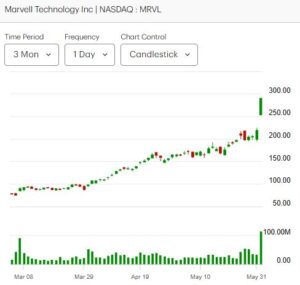
Marvell Technology delivered another exceptional performance, climbing 32.52% to close at $290.79 on massive volume of 112 million shares. Following its earnings-driven breakout, the stock experienced only a brief consolidation before resuming its upward trajectory. While the strength is impressive, the stock is now significantly extended from traditional buy points, increasing the importance of disciplined risk management.
In contrast, Dell Technologies, one of the strongest performers in the previous session, fell 6.56% as traders locked in profits following its recent advance. The divergence among AI infrastructure names highlights the increasingly selective nature of institutional capital flows.
After the closing bell, Palo Alto Networks reported quarterly results that exceeded expectations across key operating metrics. The stock initially surged approximately 12% in after-hours trading before surrendering most of those gains later in the evening, suggesting that investor expectations had already been elevated heading into the report.
Takeaways for Investors and Traders
For Investors:
- The major indexes continue to demonstrate resilience, with the Dow and S&P 500 reaching fresh record highs.
- Strong NYSE market breadth and a rising number of 52-week highs indicate that participation in the bull market remains broad.
- Leadership from Utilities, Industrials, Materials, Energy, and small-cap stocks suggests the rally is expanding beyond mega-cap technology names.
- Falling Treasury yields continue to provide a supportive backdrop for equities.
For Traders:
- The Russell 2000’s outperformance is worth monitoring, as sustained small-cap leadership could signal a broader risk-on environment.
- AI infrastructure stocks remain among the market’s strongest momentum areas, but several leaders—including Marvell and Celestica—are becoming increasingly extended and may be vulnerable to profit-taking or consolidation.
- The Nasdaq’s relatively weak breadth compared with the NYSE suggests selectivity remains important despite the market’s overall strength.
- Record highs are generally bullish, but traders should monitor volume trends closely. Recent advances have occurred on lighter volume, which can sometimes precede short-term consolidation periods.
Overall, Tuesday’s session reinforced the market’s bullish tone. Record index levels, strong breadth, expanding leadership, and continued earnings-driven momentum point to a healthy uptrend. However, with several leading stocks becoming extended and indexes sitting at historic highs, disciplined position management and adherence to proven buy-and-sell rules remain essential.
.
IMPORTANT NOTICE TO READERS
The Canadian Vanguard Stock Market’s focus is on empowering our readers to build and manage wealth by themselves. There is certainly no magic in managing finances or wealth but one needs to know what to do and commit to doing what is needed. When you are ready to start the journey to Take Charge and Put Your Destiny In Your Own Hands, read The Canadian Vanguard every market day. Stock market investing is a lot cheaper to get into, more liquid and easier than real estate investing.
Our readers are strongly advised to conduct their own research into individual stocks before making a purchase decision. In addition, investors are advised that past stock performance is no guarantee of future price appreciation. Any recommendation is not a guarantee of any particular stock’s future prices, and The Canadian Vanguard accepts no responsibility or liability for investors’ or readers’ purchases.
Stock Market Wrap Up Report and Market Strategy sections will be available from now on only to Paying Subscribers. The dollar sign “$” in the Toronto Market section in the articles only stands for Canadian dollar and in the US market section “$” stands for US dollar.
(c) This article is published by The Canadian Vanguard on June 2, 2026