







Dow Jones Surges as Small Caps and Blue Chips Lead Broad Market Rebound While Tech Stocks Retreat
The Canadian Vanguard Stock Market Report Thursday June 4, 2026 Edition
.
The Toronto Market
Thursday’s Toronto Market Index
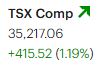
The S&P/TSX Composite Index advanced 415.52 points (1.19%) to close at 35,217.06 on Thursday. The gain fully reversed Wednesday’s pullback, with the index finishing above its previous closing level.
The TSX delivered a strong performance throughout the session. After opening above the prior day’s close, the index moved steadily higher for most of the trading day and maintained its upward momentum into the close. By the end of the session, the benchmark had gained 1.19%, reflecting broad market strength and renewed buying interest.
With Thursday’s advance, the market effectively erased the previous session’s decline, making Wednesday’s pullback a brief one-day interruption in the broader upward trend.
Thursday’s TSX Market Statistics
Market breadth was strongly positive on Thursday, with advancing issues significantly outnumbering declining issues. A total of 1,453 stocks advanced while 713 stocks declined, resulting in an advancer-to-decliner ratio of 2.04 to 1, meaning that approximately two stocks rose for every stock that fell. An additional 158 issues closed unchanged.
The TSX also recorded 207 new 52-week highs and 52 new 52-week lows, compared with 211 new highs and 50 new lows in the previous session. While the number of new highs eased slightly from yesterday, it remained substantially above the number of new lows, indicating that underlying market strength continues to be broadly based.
Trading activity increased during the session, with total volume reaching 504.6 million shares, up approximately 9.3% from 461.5 million shares traded on Wednesday. The combination of a strong index advance and higher trading volume suggests that Thursday’s rally was supported by increased investor participation rather than occurring on light turnover.
The TSX not only recovered from Wednesday’s decline but also finished well above the previous session’s close. The rise in trading volume alongside the strong price advance indicates that buyers returned to the market in force, helping to erase the prior day’s pullback and reinforcing the positive tone of the broader market.
Takeaway
Thursday’s session exhibited several constructive characteristics: a strong gain in the TSX Composite Index, positive market breadth, a healthy number of new 52-week highs relative to new lows, and increased trading volume. Together, these indicators suggest that buying interest was widespread and that the market’s upward momentum remains intact. While one day does not establish a trend on its own, the swift recovery from Wednesday’s pullback indicates that investors continue to view market weakness as a buying opportunity.
Thursday’s Toronto Market Wrap-Up Report
Thursday’s trading session was decisively bullish for Canadian equities as the S&P/TSX Composite Index surged 415.52 points, or 1.19%, to close at 35,217.06. The benchmark index not only recovered Wednesday’s decline but completely erased the pullback in a broad-based rally supported by strong market participation and increased trading volume.
Market breadth was particularly constructive, with advancing issues outnumbering declining issues by more than two-to-one. Nine of the TSX’s ten major sectors finished higher, reflecting widespread buying interest rather than a narrow, sector-specific advance.
The Technology sector led the market with a gain of 3.20%, highlighting investors’ continued appetite for growth-oriented names. Healthcare followed with a 1.85% advance, while the heavyweight Financials sector gained 1.57%, providing significant support to the broader index. Basic Materials rose 1.05%, benefiting from strength in precious metals and mining shares. Energy added 0.81%, while Utilities advanced 0.47%. Telecommunications Services was the only sector to finish lower, declining 1.15% and acting as the session’s lone laggard.
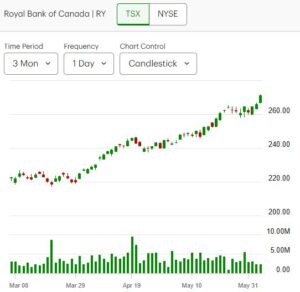
The Financials sector remained a key driver of market performance. Royal Bank of Canada continued its relative strength, rising 1.94% to close at $270.94 on volume of 2.24 million shares. Bank of Montreal gained 1.81% to finish at $229.62 with 1.42 million shares traded. Toronto-Dominion Bank advanced 1.15% to close at $158.03 on volume of approximately 3 million shares. The continued leadership from Canada’s major banks remains an encouraging signal for investors, given the sector’s significant weighting within the TSX.
Basic Materials also attracted strong buying interest. Lundin Gold Inc. was one of the session’s standout performers, surging 18.45% to close at $84.86 on volume of 524,000 shares. Franco-Nevada Corporation gained 2.95% to finish at $328.26 with 406,000 shares traded, while Agnico Eagle Mines advanced 2.94% to close at $245.74 on volume of 881,000 shares. The sector’s performance suggests investors continue to favor companies leveraged to precious metals and commodity-related themes.
Among notable individual stock movers, Telesat Corporation rallied 16.91% to close at $76.13. In the technology space, The Descartes Systems Group gained 5.31% to finish at $108.34 on volume of 823,000 shares, while Kinaxis Inc. rose 4.17% to close at $167.81 with 175,000 shares traded. In the Energy sector, Precision Drilling Corporation advanced 3.94% to close at $137.33 on volume of 88,000 shares, reflecting renewed strength in energy-related equities.
The day’s rally was accompanied by increased trading activity, with TSX volume rising approximately 9% from the previous session. The combination of higher prices, positive market breadth, and stronger volume suggests institutional and retail participation was supportive of the advance. Such characteristics typically strengthen the credibility of a market move and reduce the likelihood of it being merely a short-covering rally.
Takeaway for Traders and Investors
Thursday’s session delivered several bullish signals. The TSX posted a strong gain, market breadth was overwhelmingly positive, trading volume expanded, and sector participation was broad-based. The ability of the index to fully recover Wednesday’s pullback in a single session indicates underlying market resilience and continued investor confidence.
For traders, the leadership from Technology, Financials, and Basic Materials highlights areas where momentum remains strongest and where relative-strength opportunities may continue to emerge. For investors, the continued participation of major banks and resource stocks suggests that the market’s advance remains supported by key sectors that traditionally underpin TSX performance.
Going into the next session, traders should monitor whether buying interest remains broad and whether volume continues to support higher prices. A sustained move above recent highs, combined with continued strength in market breadth, would further reinforce the bullish intermediate-term outlook for Canadian equities.
.
The US Markets
Thursday’s U.S. Market Indexes
U.S. equities delivered a mixed but generally positive performance on Thursday, as investors rotated out of large-cap technology stocks and into cyclical, industrial, financial, and small-cap shares. The major indexes largely recovered from Wednesday’s pullback, limiting the market decline to a single session.
The Dow Jones Industrial Average led the major benchmarks, surging 874.85 points, or 1.73%, to close at 51,561.93. The Russell 2000 Index also posted a strong gain, advancing 41.81 points, or 1.45%, to finish at 2,935.33. The broader S&P 500 rose 30.63 points, or 0.41%, ending the session at 7,584.31. In contrast, the Nasdaq Composite slipped 23.02 points, or 0.09%, to close at 26,830.96 as weakness in technology stocks weighed on the index.
Market action reflected a notable rotation beneath the surface. While technology shares faced profit-taking and underperformed, investors shifted capital toward economically sensitive sectors and smaller companies. The strong gains in the Dow and Russell 2000 relative to the Nasdaq suggest that market leadership broadened beyond the mega-cap technology names that have driven much of the market’s advance in recent months.
Treasury yields also provided a supportive backdrop for equities. The yield on the 10-year U.S. Treasury note declined by two basis points during the session. Lower long-term yields can be particularly beneficial for small-cap stocks because they generally reduce financing costs and ease pressure on companies that are more sensitive to borrowing conditions. The decline in yields likely contributed to the Russell 2000’s strong relative performance.
From a technical perspective, Thursday’s rebound was constructive. The ability of the Dow, S&P 500, and Russell 2000 to recover quickly from the previous session’s weakness indicates that investor demand remains strong. The session also demonstrated that buyers were willing to step into areas of the market beyond technology, a healthy sign for the sustainability of the broader market advance.

Thursday’s U.S. Market Statistics
New York Stock Exchange (NYSE): Market breadth on the NYSE was strongly positive on Thursday, with advancing issues significantly outnumbering declining issues. A total of 3,043 stocks advanced while 1,390 declined, resulting in an advancer-to-decliner ratio of approximately 2.20 to 1. An additional 435 issues closed unchanged. The breadth figures indicate that buying interest was widespread across the exchange and not limited to a handful of large-cap stocks.
The NYSE recorded 308 new 52-week highs and 145 new 52-week lows, compared with 291 new highs and 187 new lows in the previous session. The increase in new highs combined with the decline in new lows represents an improvement in underlying market strength and suggests that more stocks are participating in the broader advance.
Total NYSE trading volume reached 5.52 billion shares, down approximately 7% from the 5.90 billion shares traded on Wednesday. While trading activity moderated, the strong positive breadth and expanding list of new highs indicate that the market’s advance remained broadly supported.
NASDAQ: Market internals were also positive on the NASDAQ despite the Nasdaq Composite Index finishing slightly lower. Advancing stocks outnumbered declining stocks by a margin of 3,168 to 1,692, producing an advancer-to-decliner ratio of approximately 1.87 to 1. An additional 374 issues were unchanged.
The divergence between the Nasdaq Composite and the exchange’s breadth statistics is noteworthy. Although the index declined modestly, largely due to weakness in several large-cap technology stocks, the majority of NASDAQ-listed companies actually advanced. This suggests that selling pressure was concentrated in a relatively small number of influential technology names rather than across the broader market.
The NASDAQ recorded 214 new 52-week highs and 147 new 52-week lows, compared with 242 new highs and 211 new lows the previous session. While the number of new highs declined modestly, the sharp reduction in new lows is an encouraging sign that underlying market conditions improved considerably.
Trading volume on the NASDAQ totaled 9.30 billion shares, approximately 5% below Wednesday’s volume of 9.77 billion shares. The lighter volume indicates somewhat less trading activity than the prior session, although market breadth remained firmly positive.
Overall Market Assessment
The combined NYSE and NASDAQ statistics paint a constructive picture of the U.S. equity market. Breadth was decisively positive on both exchanges, with advancers nearly doubling decliners. Furthermore, the expansion in new highs relative to new lows on the NYSE and the substantial reduction in new lows on the NASDAQ indicate improving internal market health.
One of the most notable aspects of Thursday’s session was the disconnect between the Nasdaq Composite Index and NASDAQ breadth. While the index slipped slightly due to weakness in several mega-cap technology stocks, the majority of stocks listed on the exchange moved higher. This suggests that investor participation broadened beyond the technology sector and into other areas of the market, including small-cap, industrial, financial, and cyclical stocks.
Takeaway for Traders and Investors
Thursday’s market internals were stronger than the headline index performance may initially suggest. Breadth was overwhelmingly positive across both major exchanges, new-high/new-low data improved, and participation broadened beyond the largest technology stocks.
For traders, the positive breadth despite Nasdaq weakness is a signal that capital may be rotating into previously overlooked sectors and smaller-cap stocks. Such rotations often create opportunities outside the market’s traditional leadership groups.
For investors, the data suggest that the current advance remains supported by a broadening base of stocks rather than relying solely on mega-cap technology names. Continued improvement in breadth and new-high statistics would be a constructive sign for the sustainability of the broader bull market.
Thursday’s U.S. Market Wrap-Up Report
Thursday’s session delivered a strong rebound for U.S. equities as investors returned to risk assets following Wednesday’s pullback. The market’s decline was limited to a single session, with buyers stepping back into the market as both oil prices and Treasury yields moved lower. The retreat in yields, particularly the two-basis-point decline in the 10-year Treasury yield, provided a supportive backdrop for equities and helped fuel a notable rally in small-cap and cyclical stocks.
The market continues to exhibit an alternating pattern of gains and declines in recent sessions, reflecting investor sensitivity to movements in interest rates and energy prices. However, Thursday’s rebound demonstrated that underlying demand for equities remains intact. The Dow Jones Industrial Average surged to another record closing high, while the Russell 2000 posted one of the strongest performances among the major indexes, highlighting renewed investor appetite for economically sensitive and interest-rate-dependent stocks.
One of the most significant developments of the session was the continued broadening of market leadership. While technology stocks and many artificial intelligence-related names experienced profit-taking, capital rotated into industrials, financials, healthcare, utilities, and other value-oriented sectors. This type of rotation is generally viewed as constructive because it expands participation in the rally and reduces dependence on a narrow group of mega-cap technology stocks.
The divergence among the major indexes reflected this rotation. The Dow Jones Industrial Average and the Russell 2000 were the session’s clear leaders, while the Nasdaq Composite finished slightly lower as weakness in several large-cap technology and AI-related stocks weighed on the index. Despite this, both the Nasdaq and the S&P 500 recovered significantly from their intraday lows, suggesting that selling pressure remained contained and buyers were willing to step in on weakness.
Sector performance reinforced the rotation theme. Six of the eleven major sectors finished higher. Healthcare led the market with a gain of 2.97%, followed by Financials, which advanced 2.37%. Industrials gained 1.06%, Utilities rose 0.58%, and Energy added 0.30%. Technology slipped 0.18%, while Communication Services was the weakest-performing sector, declining 2.08%.
In company-specific action, semiconductor and optical networking stocks faced heavy selling pressure. Sandisk Corporation declined 3.92%, while Micron Technology fell 7.74%. Celestica Inc. dropped 7.22% to close at $425.08 on volume of 2.9 million shares and has now declined more than 10% over the past two sessions. Broadcom Inc. was one of the session’s most notable losers, falling 12.59% to close at $418.91 on heavy volume of 80.9 million shares. Ciena Corporation also came under significant pressure, declining 13.66% on volume of 7.6 million shares. The weakness in Broadcom and Ciena reflected a broader pullback across portions of the AI and high-growth technology segments.
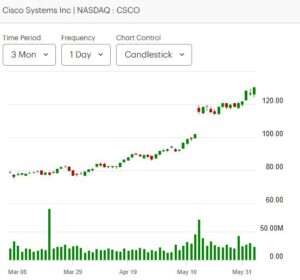
Not all technology-related stocks participated in the sell-off. Marvell Technology continued its recent momentum, rising 4.90% to close at $316.43 on exceptionally strong volume of 86.8 million shares. Cisco Systems advanced 2.77% to close at $130.00 on volume of 23.3 million shares. Among AI-related names, Alphabet and Comfort Systems posted bullish gains, demonstrating that investors remain selective rather than broadly abandoning the AI theme.
Market internals painted a more constructive picture than the headline Nasdaq performance suggested. Advancers significantly outnumbered decliners on both the NYSE and NASDAQ, while new highs continued to exceed new lows. These statistics indicate that the rally broadened beyond the largest technology companies and that buying interest remained widespread across the market.
Takeaway for Traders and Investors
Thursday’s session was characterized by healthy sector rotation rather than broad market weakness. While AI and semiconductor stocks experienced profit-taking, capital flowed into financials, healthcare, industrials, utilities, and small-cap stocks. The strong gains in the Dow Jones Industrial Average and Russell 2000, combined with positive market breadth, suggest that the bull market is expanding beyond its traditional technology leadership.
For traders, the emergence of leadership in financials, healthcare, industrials, and small-cap stocks may present new momentum opportunities if the rotation continues. Monitoring relative strength in these groups could be particularly important over the coming sessions.
For investors, the combination of declining Treasury yields, strong market breadth, and broad sector participation is encouraging. A market advance supported by multiple sectors is generally more sustainable than one driven by a handful of mega-cap stocks. If Treasury yields remain stable or continue to trend lower, small-cap and value-oriented stocks could continue to attract investor interest.
The key question heading into the next session is whether technology and AI-related stocks stabilize while the broader market maintains its strength. If both conditions occur simultaneously, the market could enter a more balanced and durable phase of the current bull trend.
.
IMPORTANT NOTICE TO READERS
The Canadian Vanguard Stock Market’s focus is on empowering our readers to build and manage wealth by themselves. There is certainly no magic in managing finances or wealth but one needs to know what to do and commit to doing what is needed. When you are ready to start the journey to Take Charge and Put Your Destiny In Your Own Hands, read The Canadian Vanguard every market day. Stock market investing is a lot cheaper to get into, more liquid and easier than real estate investing.
Our readers are strongly advised to conduct their own research into individual stocks before making a purchase decision. In addition, investors are advised that past stock performance is no guarantee of future price appreciation. Any recommendation is not a guarantee of any particular stock’s future prices, and The Canadian Vanguard accepts no responsibility or liability for investors’ or readers’ purchases.
Stock Market Wrap Up Report and Market Strategy sections will be available from now on only to Paying Subscribers. The dollar sign “$” in the Toronto Market section in the articles only stands for Canadian dollar and in the US market section “$” stands for US dollar.
(c) This article is published by The Canadian Vanguard on June 4, 2026