







The Canadian Vanguard Stock Market Report Weekend June 5-7, 2026 Edition
Nasdaq and Small Caps Lead Friday’s Sell-Off as Strong Jobs Data Revives Interest Rate Hike Fears
The Canadian Vanguard Stock Market Report is updated regularly during the weekend
.
The Toronto Market
Friday’s Toronto Market Index
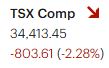
The Toronto S&P/TSX Composite Index declined 803.61 points (-2.28%) on Friday to close at 34,413.45. The index opened below the previous session’s close and weakened throughout the day, finishing near its lows. The decline was led by weakness in technology shares and broad-based profit-taking after a strong advance. The market had become somewhat extended following recent gains, making it vulnerable to a pullback. While Friday’s decline was significant, a single-session sell-off does not by itself signal the start of a correction. At this stage, the move appears more consistent with profit-taking and short-term risk reduction than with a major trend reversal. Additional downside sessions and a decline of 10% or more from recent highs would be needed before classifying the move as a correction.
Technically, here are some points for traders and investors to note:
- The magnitude of the decline increases the probability of additional near-term volatility.
- Whether this becomes a correction depends on follow-through selling during the next several sessions.
- Watch market breadth, trading volume, and leadership sectors. If weakness spreads beyond technology and cyclical sectors, the risk of a larger correction increases.
- If buyers return to the market in the early days of next week, and the index recovers a meaningful portion of Friday’s losses, the decline may ultimately be viewed as a healthy pullback within an ongoing uptrend.
Friday’s Toronto Market Wrap-Up Report
The Toronto market experienced a broad sell-off on Friday, with the S&P/TSX Composite Index declining sharply as investors locked in profits following recent market gains. Despite the weakness in the broader market, only four major sectors managed to finish the session in positive territory. Healthcare led all gainers, advancing 3.76%, followed by Utilities (+0.44%), Telecommunications Services (+0.28%), and Financials (+0.04%).
The TSX has recently experienced a pattern of alternating gains and declines, suggesting a period of consolidation following a strong advance. Friday’s weakness, however, was concentrated primarily in the Technology and Basic Materials sectors rather than representing indiscriminate selling across the entire market.
Technology stocks accounted for a significant portion of the market’s decline. Celestica Inc. fell 12.25% (-$72.44) to close at $518.57 on volume of 548,660 shares. The stock has been one of the market’s strongest performers over the past year, making it particularly vulnerable to profit-taking after its substantial advance. Shopify Inc. declined 5.41% to close at $152.79 with 1.48 million shares traded. Shopify has remained below its 25-day and 50-day moving averages for some time, indicating that investors have remained cautious toward the stock despite periodic rallies.
Consumer discretionary names were comparatively resilient. Aritzia Inc., another strong long-term performer, declined 2.02%. While the pullback was notable, it did not exhibit the characteristics of the heavier selling pressure seen in several technology and resource stocks.
Among individual outperformers, Dollarama Inc. gained 3.04% to close at $181.22 on volume of 1.05 million shares, demonstrating continued investor confidence in defensive retail names amid market volatility.
Basic Materials and precious metals stocks also came under significant pressure. Kinross Gold Corporation fell 8.17% to $36.50, Franco-Nevada Corporation declined 7.20% to $304.64, Wheaton Precious Metals Corp. dropped 9.35% (-$16.70) to $161.89, and Agnico Eagle Mines Limited retreated 7.21% (-$17.72) to close at $228.02. These stocks had previously experienced strong advances and appeared vulnerable to profit-taking activity.
BlackBerry Limited also experienced heavy selling pressure, falling 9.17% to close at $13.08 on volume exceeding 10 million shares.
Overall, Friday’s market action appears to have been driven primarily by profit-taking in stocks that had become extended following substantial gains. While the decline was significant, the selling was concentrated in specific sectors and individual names rather than reflecting broad-based deterioration in market fundamentals.
Traders and Investors Takeaway
Friday’s sell-off should be viewed as a warning sign to monitor rather than evidence of a developing market correction. Market leadership stocks, particularly in Technology and Basic Materials, experienced substantial profit-taking after extended advances. Traders should watch whether selling pressure continues into the coming week or whether buyers step in to support key technical levels.
For active traders, elevated volatility may create short-term opportunities, but risk management remains critical while the market digests recent gains. Investors should focus on relative strength, as sectors such as Healthcare, Utilities, Telecommunications Services, and Financials demonstrated resilience during Friday’s decline.
The key question for next week is whether Friday’s weakness remains a one-day profit-taking event or develops into a broader correction. At present, the evidence suggests a healthy pullback within an ongoing uptrend rather than the beginning of a sustained bearish trend. Follow-through selling, market breadth, and volume patterns will be important indicators to watch in the coming sessions.
.
The US Markets
Friday’s U.S. Market Indexes
U.S. equities suffered a broad and significant sell-off on Friday, with technology and small-cap stocks leading the decline. All major market indexes closed sharply lower as rising Treasury yields and stronger-than-expected employment data fueled concerns that interest rates could remain elevated for longer than previously anticipated.
The Dow Jones Industrial Average declined 695.15 points, or 1.35%, to close at 50,866.78. The S&P 500 dropped 200.57 points, or 2.64%, ending the session at 7,383.74. The Nasdaq Composite experienced the steepest decline among the major indexes, plunging 1,121.35 points, or 4.18%, to close at 25,709.43. Meanwhile, the Russell 2000 Index, which tracks small-cap stocks, fell 101.83 points, or 3.17%, to finish the session at 2,833.50.
Friday’s decline was particularly severe in the technology sector. A one-day decline exceeding 4% in the Nasdaq Composite is a notable market event given the index’s broad composition and concentration of growth-oriented companies. The sharp drop reflected aggressive selling pressure across many of the market’s leading technology stocks as investors reduced exposure to higher-valuation growth names.
Small-cap stocks also came under significant pressure. Rising Treasury yields tend to weigh more heavily on smaller companies because of their greater sensitivity to borrowing costs and financing conditions. Additionally, stronger-than-expected employment data reinforced concerns that economic strength could delay future interest-rate cuts or potentially increase the risk of further monetary tightening if inflationary pressures persist.
Market internals confirmed the intensity of the sell-off. Nasdaq trading volume increased approximately 28% from the previous session, indicating strong institutional participation in the decline. Higher volume accompanying a sharp market drop is often viewed as a sign of conviction selling. In contrast, volume on the New York Stock Exchange increased by only about 3%, suggesting that the most aggressive selling activity was concentrated in technology and growth-oriented stocks listed on the Nasdaq.
While the magnitude of Friday’s decline was significant, it is important to note that sharp sell-offs often occur after extended market advances as investors lock in profits and reassess valuations. Whether this develops into a broader market correction will depend on the level of follow-through selling and the market’s ability to find support during the coming week.

Friday’s U.S. Market Statistics
New York Stock Exchange (NYSE): Market breadth on the NYSE was decisively negative on Friday, with declining issues significantly outnumbering advancing issues. The exchange recorded 3,452 declining stocks compared with 1,101 advancing stocks, while 385 issues finished unchanged. This produced a decliner-to-advancer ratio of approximately 3.1-to-1, indicating broad selling pressure across the market.
New 52-week lows also exceeded new 52-week highs by a wide margin. The NYSE recorded 132 new highs and 249 new lows, a notable deterioration from Thursday’s session when 308 stocks reached new highs compared with 145 new lows. The sharp reversal in the new highs/new lows data suggests a meaningful weakening in market momentum.
Total NYSE trading volume reached 5.70 billion shares, representing a modest 3% increase from Thursday’s volume of 5.52 billion shares. While selling pressure was widespread, the relatively small increase in volume suggests that institutional distribution was less intense on the NYSE than on the Nasdaq.
NASDAQ: Market breadth was considerably weaker on the Nasdaq, reflecting the heavy selling pressure in technology and growth-oriented stocks. Declining issues totaled 3,846 compared with 1,084 advancing issues, while 150 stocks finished unchanged. This resulted in a decliner-to-advancer ratio of approximately 3.55-to-1, meaning more than three stocks declined for every stock that advanced.
The new highs/new lows statistics also deteriorated sharply. The Nasdaq recorded 124 new 52-week highs and 290 new 52-week lows, compared with 214 new highs and 147 new lows on Thursday. The substantial increase in new lows highlights the extent of Friday’s weakness and confirms that selling pressure extended beyond a handful of large-cap technology names.
Trading activity surged on the Nasdaq, with total volume reaching 11.97 billion shares, a 28% increase from Thursday’s volume of 9.30 billion shares. The combination of sharply higher volume and a 4.18% decline in the Nasdaq Composite suggests strong institutional participation in the sell-off. High-volume declines are often viewed by traders as evidence of conviction selling and warrant close monitoring for potential follow-through weakness.
Market Breadth Summary
Friday’s market statistics reflected a significant deterioration in market breadth and investor sentiment. Both exchanges experienced substantially more declining than advancing stocks, while new 52-week lows expanded and new highs contracted sharply from the previous session.
The most concerning statistic was the Nasdaq’s 28% surge in trading volume accompanying a steep market decline. This combination points to aggressive selling activity in technology and growth stocks and suggests that institutions were actively reducing exposure rather than simply retail investors taking profits.
Although the data clearly reflects a bearish session, market weakness remained most concentrated in technology and growth-oriented sectors. Traders and investors should watch closely for follow-through selling next week, particularly if new lows continue to expand and volume remains elevated.
Friday’s U.S. Market Wrap-Up Report
Wednesday’s market sell-off returned with renewed intensity on Friday as investors reacted to stronger-than-expected employment data. The robust labor market report reinforced expectations that the economy remains resilient, but it also raised concerns that interest rates could remain elevated for longer or that the possibility of additional monetary tightening cannot be entirely dismissed. Rising Treasury yields added further pressure on equity valuations, particularly within growth-oriented sectors.
While the major indexes suffered broad declines, the heaviest selling was concentrated in technology, artificial intelligence infrastructure, semiconductors, and related communications equipment companies. Many of the market’s strongest-performing stocks over the past year experienced aggressive profit-taking as investors reduced exposure to higher-valuation growth names.
Semiconductor and chip stocks led the decline. Intel Corporation (INTC) fell 11.28% to close at $99.17 on volume of 145.21 million shares. Advanced Micro Devices (AMD) declined 10.86% to $466.38 with 46.9 million shares traded, while ARM Holdings Plc (ARM) dropped 12.80% to close at $342.93 on volume of 14.89 million shares. The sector faced broad selling pressure as investors reassessed growth expectations amid rising yields and changing interest-rate expectations.
Storage and memory manufacturers also experienced significant weakness. Sandisk Corp. (SNDK) declined 11.38%, Micron Technology (MU) fell 13.52%, and Seagate Technology Holdings Plc (STX) lost 8.48%. The magnitude of the declines reflects the market’s reduced appetite for high-growth technology stocks following an extended period of strong performance.
The weakness extended into optical networking and communications equipment suppliers, many of which have benefited from increased demand related to artificial intelligence infrastructure buildouts. Applied Optoelectronics Inc. (AAOI) declined 12.71% on volume of 19.8 million shares, while Lumentum Holdings Inc. (LITE) fell 8.65% on volume of 7.54 million shares.
One notable catalyst for the sector’s weakness was the negative reaction to Broadcom Inc.’s earnings announcement released after Thursday’s market close. Investor disappointment toward one of the AI infrastructure sector’s key companies contributed to broader selling across semiconductor, networking, and optical equipment stocks.
Although Friday’s market decline was significant, the selling remained heavily concentrated in specific technology-related sectors rather than spreading evenly across all areas of the market. The session was characterized by aggressive profit-taking in stocks that had substantially outperformed during the market’s recent advance.
Traders and Investors Takeaway
Friday’s market action represented a meaningful deterioration in short-term sentiment, particularly within technology, artificial intelligence, semiconductor, and growth-oriented stocks. Rising Treasury yields, strong economic data, and elevated institutional selling pressure combined to create a challenging environment for risk assets.
For traders, the sharp increase in volatility suggests that near-term market conditions may remain unsettled. Close attention should be paid to key support levels, market breadth, and volume patterns. Stocks that have delivered exceptional gains over recent months may remain vulnerable to further profit-taking and position adjustments.
For investors, Friday’s decline should be viewed within the broader context of the prevailing market trend. A single sharp sell-off does not automatically signal the beginning of a bear market or major correction.
The key question heading into next week is whether Friday’s decline represents a healthy pullback within an ongoing bull market or the early stages of a more meaningful corrective phase. Additional high-volume selling, particularly in market-leading technology stocks, would increase the probability of a deeper correction. Conversely, stabilization in Treasury yields, improving market breadth, and renewed buying interest could indicate that Friday’s weakness was primarily a profit-taking event rather than a lasting change in the market’s longer-term trend.
.
NOTICE TO READERS
The Canadian Vanguard Stock Market is about empowering you to build and manage your wealth by yourself. There is certainly no magic in managing finances or wealth but one needs to know what to do and commit to doing what is needed. When you are ready to start the journey to Take Charge and Put Your Destiny In Your Own Hands, read The Canadian Vanguard every market day. If you need more related information, Contact Us
Our readers are strongly advised to conduct their own research into individual stocks before making a purchase decision. In addition, investors are advised that past stock performance is no guarantee of future price appreciation. Any recommendation is not a guarantee of any particular stock’s future prices, and The Canadian Vanguard accepts no responsibility or liability for investors’ or readers’ purchases.
Stocks In The News/ Stocks To Watch and Market Strategy will soon be available only to Paying Subscribers. The dollar sign “$” in the Toronto Market section in the articles only stands for Canadian dollar and in the US market section “$” stands for US dollar.
(c) This article is published by The Canadian Vanguard on June 7, 2026