







Canada Defies Expectations with Resilient Population Growth Trends
After several years of spectacular population growth in Canada, the story of 2026 has been the country experiencing the first outright population decline since Confederation.
While Canada showed a small quarter-over-quarter population decline during the fall months of 2025, revised numbers now show the population has generally been growing – contrary to previous counts that pointed to consistent and sizeable decreases.
As of July 1, Canada added roughly 190,000 people since the same date last year, a 0.5-per-cent increase that brought the country’s population to 41.8 million, according to Statistics Canada.
At the same time, the agency revised Canada’s population count going back to 2021, with the biggest changes occurring since mid-2025. Under the agency’s previous count, Canada’s population shed 236,000 from that point to April 1 this year. With the update, Canada actually added 190,000 people, instead.
“Rapid changes to immigration policies in recent years have not only made the future trajectory of the population much more volatile … even recent history may be subject to change,” Daren King and Matthieu Arseneau, economists at National Bank of Canada, wrote in a note.
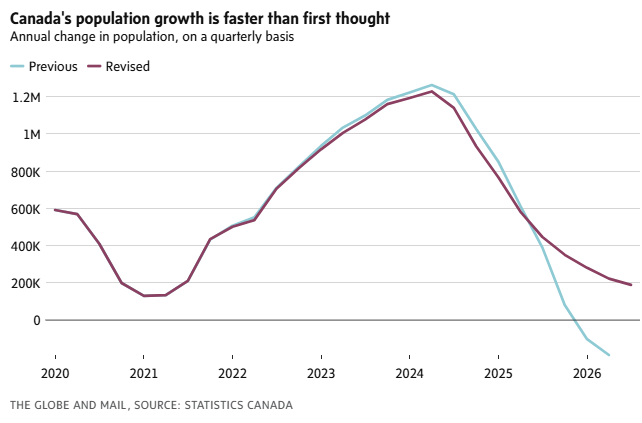
The agency regularly revises its past population counts, but this revision was particularly large.
The economists determined most of the adjustment in population came down to the estimated number of non-permanent residents. Statscan revised that number higher after changing how it counts non-permanent residents leaving the country, and those staying while permit extensions are processed.
The government has set a goal of shrinking the non-permanent resident population to 5 percent of the total population by the end of 2027. The revised count shows that share is declining more slowly than originally thought. That will make it difficult for the government to reach its target, the economists wrote.
With demographic data in such flux, it’s all the more tricky for economists and policy-makers to gauge vital economic indicators around employment, housing and productivity.
Even something as fundamental as forecasting economic growth becomes more difficult.
Under the old population count, real per-capita gross domestic product in the second quarter leapt 1.6 per cent from the year before. With the revelation that Canada’s population growth was stronger than expected, per-capita growth shrank a full percentage point.
Tis article was first reported by Te lobe and Mail