






Markets Whipsaw as Geopolitical Risks Resurface and the U.S.-Iran Ceasefire Shows Signs of Strain
The Canadian Vanguard Stock Market Report Tuesday June 9, 2026 Edition
.
The Toronto Market
Tuesday’s Toronto Market Index
The Toronto S&P/TSX Composite Index fell 67.05 points, or 0.19%, to close at 34,411.69. After declining 2.28% on Friday and rebounding 0.19% on Monday, the TSX slipped another 0.19% today. As a result, the index is now trading almost exactly where it closed on Friday.
This recent back-and-forth movement suggests that the character of the market may be changing. The strong, persistent rally that has driven the TSX higher appears to have stalled, at least for the time being. Whether this proves to be a temporary pause or the beginning of a broader consolidation remains to be seen.
One of the most important traits of successful investing is learning to respect the market’s signals. Given the recent shift in momentum, a more cautious approach may be warranted in the near term.


Tuesday’s TSX Market Statistics
On the TSX, declining issues outnumbered advancing issues, with 1,252 decliners compared with 980 advancers, while 149 issues closed unchanged. This produced a decliner-to-advancer ratio of 1.27 to 1, or approximately six decliners for every five advancers, indicating negative market breadth.
The exchange recorded 95 new 52-week highs and 45 new 52-week lows, compared with 76 new highs and 32 new lows yesterday. While the number of new highs increased, so did the number of new lows, suggesting a market that remains selective rather than broadly strong.
Total trading volume reached 516.4 million shares, approximately 7% above yesterday’s volume of 480.2 million shares. However, overall trading activity remains within its normal 50-week average range, indicating no unusual surge in participation.
The number of stocks reaching new 52-week highs continues to remain within a relatively narrow range, reflecting a market that is holding its ground but lacks strong upside momentum. Investors appear to be waiting for greater clarity regarding developments involving the United States and Iran before committing significant new capital. Such caution is understandable, as geopolitical uncertainty often encourages investors to adopt a more defensive posture.
As long as market sentiment remains heavily influenced by geopolitical headlines, a cautious trading environment is likely to persist. There appears to be some reluctance among investors to push stock prices materially higher, and Friday’s sharp selloff remains the most significant recent market event. Until a stronger catalyst emerges, the market may continue to move sideways while participants assess both geopolitical risks and economic fundamentals.
Tuesday’s Toronto Market Wrap-Up Report
The TSX gave back Monday’s modest gain on Tuesday, leaving the index little changed from Friday’s close. Friday’s sharp selloff continues to define the market’s trading range and remains the most significant recent market event. The market’s character appears to be shifting from one driven by optimism and momentum to one increasingly influenced by geopolitical uncertainty.
At present, geopolitical developments involving the United States and Iran appear to be exerting a greater influence on investor sentiment than economic forecasts or corporate planning. As a result, market participants remain cautious, reacting to headlines rather than aggressively positioning for future growth.
Only five sectors finished the session higher. Consumer-oriented and financial stocks provided most of the market’s leadership. Durable Consumer Goods & Services led all sectors with a gain of 1.99%, followed by Financials, up 0.92%, and Discretionary Consumer Goods & Services, which advanced 0.48%.
Technology stocks weakened, falling 0.35%, while Energy declined 1.74%. Basic Materials was the weakest-performing sector, down 1.84%. Weakness in Basic Materials is often a warning sign for the TSX because of the significant weighting of mining and resource companies within the index. When resource stocks struggle, it is often difficult for the broader TSX to generate sustained upward momentum.
Company Highlights
Aritzia Inc. recorded another 52-week high and continues to demonstrate exceptional relative strength. The stock has been a consistent outperformer and remains one of the stronger names within the Canadian retail sector.
Two of Canada’s major banks, Royal Bank of Canada and Bank of Montreal, also reached new 52-week highs, underscoring the ongoing strength within the financial sector. The ability of leading financial institutions to reach new highs despite broader market uncertainty remains a constructive signal for the TSX.
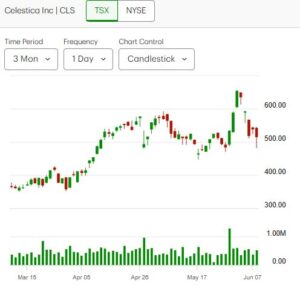
Technology names experienced some pressure. Celestica Inc. (CLS) declined 4.15%, making it one of the more notable losers among large-cap technology stocks. Shopify Inc., another influential TSX technology component, slipped a more modest 0.34%. Given Shopify’s substantial weighting within the index, its direction remains important for overall TSX performance.
TerraVest Industries Inc. (TVK) was among the session’s strongest performers, rising 6.00% to close at $115.22 on volume of approximately 208,700 shares. The gain came despite reports that Canaccord Genuity reduced its price target on the stock from $190.00 to $140.00 per share, suggesting investors remain confident in the company’s longer-term prospects.
🔒 Premium Content
You must be a subscriber to access the remaining parts of this section. Current subscription rate is $60 CAD for a year
Login or Subscribe
.
The US Markets
Tuesday’s U.S. Market Indexes
U.S. equities finished Tuesday’s session mixed, with small-cap stocks leading the market while technology shares experienced significant selling pressure.
The Dow Jones Industrial Average gained 86.10 points, or 0.17%, to close at 50,872.11. The S&P 500 declined 19.08 points, or 0.26%, ending the session at 7,386.65. The Nasdaq Composite suffered the largest decline among the major indexes, falling 250.84 points, or 0.97%, to close at 25,678.82. Meanwhile, the Russell 2000 Index outperformed, advancing 11.60 points, or 0.41%, to finish at 2,867.02.
The market’s leadership rotated away from large-cap technology stocks and toward small-cap and interest-rate-sensitive sectors. One of the primary drivers was a modest decline in the 10-year Treasury yield, which fell by two basis points during the session. Oil prices also moved lower.
The combination of declining bond yields and lower oil prices provided support for smaller companies, which are generally more sensitive to financing costs and economic expectations. Lower energy prices may also help ease inflation concerns, reducing fears that the Federal Reserve could be forced to maintain a restrictive interest-rate policy for longer than expected.
Technology stocks, particularly semiconductor and chip-related companies, came under heavy selling pressure shortly after the opening bell. Although the sector recovered some ground during the afternoon session, the early losses were too substantial to overcome. The weakness suggests that investors may be reassessing valuations within parts of the technology sector following an extended period of strong performance.
There were also signs of sector rotation, with some investors moving capital into areas of the market that have lagged in recent months. Several real estate stocks posted gains as lower bond yields improved the outlook for interest-rate-sensitive sectors.
Geopolitical developments continued to influence market sentiment. Reports regarding escalating tensions between the United States and Iran contributed to investor caution throughout the session. As has been the case in recent weeks, market direction remains heavily influenced by geopolitical headlines, resulting in increased volatility and less consistent upward momentum.
The major indexes are no longer advancing on a session-by-session basis. Instead, investors appear to be weighing the competing forces of economic fundamentals, interest-rate expectations, and geopolitical risks, producing a market that is increasingly selective and rotational in nature.
Takeaway for Traders
The market is showing clear signs of sector rotation. Technology stocks, particularly semiconductors, experienced meaningful profit-taking while small-cap and rate-sensitive sectors attracted buying interest. Traders should continue monitoring Treasury yields, oil prices, and geopolitical developments, as these factors are currently exerting significant influence on short-term market direction. Until volatility subsides, flexibility and disciplined risk management remain essential.
Takeaway for Investors
The mixed performance among the major indexes suggests that the bull market remains intact but is broadening beyond large-cap technology leadership. Strength in small-cap stocks and selected interest-rate-sensitive sectors may indicate investors are seeking opportunities in areas that have lagged the market’s recent advance. Long-term investors should remain focused on portfolio quality while recognizing that geopolitical uncertainty may continue to create short-term market fluctuations and sector rotations.

Tuesday’s U.S. Market Statistics
New York Stock Exchange (NYSE): Market breadth on the NYSE was modestly positive, with advancing issues narrowly outnumbering declining issues. There were 2,585 advancing stocks compared with 1,944 declining stocks, while 430 issues closed unchanged. This resulted in an advancer-to-decliner ratio of 1.33 to 1, or approximately six advancing stocks for every five declining stocks.
The exchange recorded 208 new 52-week highs and 190 new 52-week lows, compared with 129 new highs and 162 new lows recorded yesterday. While new highs increased significantly, the elevated number of new lows suggests that investor participation remains selective rather than broadly bullish.
Total NYSE trading volume reached 6.12 billion shares, an increase of 22% from the 5.01 billion shares traded yesterday. The higher volume indicates increased investor activity as market participants reacted to changing interest-rate expectations, commodity prices, and geopolitical developments.
NASDAQ: Market breadth on the NASDAQ was essentially neutral. Advancing stocks slightly outnumbered declining stocks, with 2,494 advancers and 2,378 decliners, while 353 issues were unchanged. This produced an advancer-to-decliner ratio of 1.05 to 1, indicating an almost evenly balanced market despite the sharp decline in the NASDAQ Composite Index.
The NASDAQ Composite experienced significant selling pressure early in the session, falling sharply before reversing course around midday. Although the index finished the day in negative territory, it recovered substantially from its intraday low. The rebound demonstrated that buyers were willing to step in at lower levels despite persistent weakness in technology and semiconductor stocks.
The NASDAQ Composite also reached its lowest level since April 30 during the session. However, investors may take some encouragement from the fact that the index recovered roughly 700 points from its intraday low before the closing bell. While the decline remains noteworthy, the strong recovery suggests that panic selling did not develop and that buyers remain active when valuations become more attractive.
The exchange recorded 207 new 52-week highs and 255 new 52-week lows, compared with 149 new highs and 195 new lows yesterday. The fact that new lows continued to outnumber new highs reflects the underlying weakness that remains present in portions of the technology sector.
Total NASDAQ trading volume reached 12.57 billion shares, up 19% from yesterday’s volume of 10.58 billion shares. The increase in volume confirms the intensity of today’s trading activity and highlights the heightened level of investor engagement amid ongoing market volatility.
Tuesday’s U.S. Market Wrap-Up Report
U.S. equity markets remained sensitive to developments in the Middle East as investors continued to monitor reports surrounding tensions between the United States and Iran. News that Iran reportedly downed a U.S. Apache helicopter and that the United States would respond appropriately added another layer of uncertainty to an already fragile ceasefire situation. While the geopolitical headlines initially weighed on sentiment, investors appeared to become less reactive as the trading session progressed. Nevertheless, stock index futures were modestly lower following the close, indicating that geopolitical concerns remain firmly on investors’ radar.
Market participants also received support from lower commodity and interest-rate pressures. Crude oil prices declined modestly, while the benchmark 10-year Treasury yield fell by two basis points. The combination of lower oil prices and lower bond yields helped ease inflation concerns and supported interest-rate-sensitive sectors of the market.
Eight of the eleven major S&P sectors finished the session higher. Healthcare led the market with a gain of 1.53%, followed by Durable Consumer Goods & Services, up 1.15%, and Financials, which advanced 0.99%. Basic Materials also posted a solid gain of 0.85%.
Technology and Energy were the weakest sectors. Technology declined 1.34% as investors continued to take profits in many of the market’s strongest-performing growth stocks. Energy fell 1.47% as lower oil prices pressured the sector.
One of the most notable developments was the continued evidence of sector rotation. Real estate equities performed strongly as lower bond yields improved the outlook for income-producing assets. Several real estate investment trusts (REITs) posted significant gains and recorded technical breakouts, suggesting renewed institutional interest in the sector.
Among storage-focused REITs, Public Storage (PSA) gained nearly 4% and broke above a key technical resistance level. National Storage Affiliates Trust (NSA) advanced 3.6% and also completed a breakout from a consolidation pattern. Simon Property Group (SPG) rose 3.3%, while Tanger Inc. (SKT) surged 6.6%, both demonstrating renewed strength within the retail real estate segment.
Leadership also broadened beyond the technology sector. Hotel operator Marriott International continued to display relative strength, while fuel-cell companies attracted investor interest. Bloom Energy (BE) advanced 2.38% on heavy trading volume, reflecting continued enthusiasm for alternative energy and power-generation themes.
By contrast, semiconductor and chip-related stocks experienced notable weakness. The technology sector’s recent leadership appears to be undergoing a period of consolidation as investors rotate capital toward sectors that have lagged during the market’s advance. While this does not necessarily signal the end of the technology bull market, it does suggest that leadership is becoming more diversified.
SanDisk Corporation remains one example of a stock that continues to hold substantial gains despite recent volatility. Investors who established positions months ago still have a meaningful profit cushion, allowing them greater flexibility in managing short-term market fluctuations.
Overall, the market appears to be entering a new phase. The relentless upward momentum that characterized much of the recent advance has begun to slow, while sector rotation, geopolitical uncertainty, and shifting interest-rate expectations are exerting greater influence on day-to-day trading. The market remains constructive, but it is becoming increasingly selective.
🔒 Premium Content
You must be a subscriber to access the remaining parts of this section. Current subscription rate is $60 CAD for a year
Login or Subscribe
.
NOTICE TO READERS
The Canadian Vanguard Stock Market is about empowering you to build and manage your wealth by yourself. There is certainly no magic in managing finances or wealth but one needs to know what to do and commit to doing what is needed. When you are ready to start the journey to Take Charge and Put Your Destiny In Your Own Hands, read The Canadian Vanguard every market day. If you need more related information, Contact Us
Our readers are strongly advised to conduct their own research into individual stocks before making a purchase decision. In addition, investors are advised that past stock performance is no guarantee of future price appreciation. Any recommendation is not a guarantee of any particular stock’s future prices, and The Canadian Vanguard accepts no responsibility or liability for investors’ or readers’ purchases.
Stocks In The News/ Stocks To Watch and Market Strategy will soon be available only to Paying Subscribers. The dollar sign “$” in the Toronto Market section in the articles only stands for Canadian dollar and in the US market section “$” stands for US dollar.
(c) This article is published by The Canadian Vanguard on June 9, 2026