







Major Market Indexes Advance as Treasury Yields Retreat Though Slightly
The Canadian Vanguard Stock Market Report Tuesday, September 22, 2026, Edition
.
The Toronto Market
Tuesday’s Toronto Market Index
The Toronto S&P/TSX Composite Index advanced 326.21 points, or 0.91%, to close at 36,335.61.
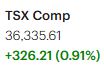

The TSX posted another gain today, marking two consecutive sessions of advances. More importantly, the index strengthened considerably, with today’s gain nearly doubling yesterday’s increase.
The TSX has now reversed the damage caused by the heavy declines earlier last week. The index is looking stronger and is consolidating its climb above the 36,000 level. The next major target is the 37,000 level.
The TSX is now back above both its 25-day and 50-day moving averages. The index has also remained consistently above its 200-day moving average, maintaining a comfortable gap above this longer-term trend indicator.
Tuesday’s TSX Market Statistics
At the TSX, advancing issues (advancers) significantly outnumbered declining issues (decliners). Specifically, there were 1,507 advancers and 716 decliners, producing an advancer-to-decliner ratio of 2.10 to 1 — approximately two advancers for every decliner. A total of 151 issues were unchanged.
The exchange recorded 97 new 52-week highs and 46 new 52-week lows, compared with 71 new 52-week highs and 40 new 52-week lows yesterday. Market breadth was positive and strengthened further today. The ratio of new 52-week highs to new 52-week lows improved to slightly better than 2 to 1, representing a considerable improvement from last week, when new 52-week lows were dominant.
The number of new 52-week highs increased by approximately 37% from yesterday, while the number of new 52-week lows increased by 15%. Overall, the Toronto market’s internal indicators have improved significantly compared with last week.
Total trading volume on the TSX reached 466,877,332 shares, approximately 8% higher than yesterday’s volume of 431,886,434 shares. The TSX index rose today on higher trading volume, which can be viewed as a potentially constructive sign for the current uptrend. The combination of rising prices, improving market breadth, and increased volume suggests that the recent advance is gaining some momentum.
Tuesday’s Toronto TSX Market Wrap-Up Report
The Toronto S&P/TSX Composite Index extended its rebound on Tuesday, advancing 326.21 points, or 0.91%, to close at 36,335.61. It was the second consecutive session of gains following the market’s weak performance earlier last week.
Tuesday’s session was broadly constructive. The TSX strengthened considerably, with today’s gain nearly doubling Monday’s advance. The index has now recovered the losses from the sharp declines earlier last week and is consolidating above the important 36,000 level.
Seven of the TSX’s ten major sectors finished higher. Technology was the standout performer, surging 4.60%. Basic Materials, Healthcare and Industrials also posted strong gains of 3.39%, 1.92% and 1.84%, respectively. Consumer Discretionary Goods & Services gained 0.82%, while Consumer Durable Goods & Services advanced 0.74%.
The downside was concentrated in several sectors. Telecommunications Services was Tuesday’s weakest sector, falling 1.64%. Financials declined 0.77%, while Energy slipped 0.71%.
Market Breadth Strengthens
Market breadth improved significantly. Advancing issues outnumbered declining issues by 1,507 to 716, producing an advancer-to-decliner ratio of 2.10 to 1. In other words, there were approximately two advancing issues for every declining issue, with 151 issues unchanged.
The new-high/new-low figures were also constructive. The TSX recorded 97 new 52-week highs and 46 new 52-week lows, compared with 71 new highs and 40 new lows on Monday. The ratio of new 52-week highs to new 52-week lows therefore improved to slightly better than 2 to 1.
This represents a substantial improvement from last week, when new 52-week lows were dominant. The number of new 52-week highs increased by approximately 37% from Monday, while new 52-week lows increased by 15%.
Taken together, the advancing/declining issues and new-high/new-low statistics indicate that the improvement in the TSX is becoming broader rather than being driven solely by a small number of large-cap stocks.
Volume Provides Additional Confirmation
Total TSX trading volume reached 466.88 million shares, approximately 8% above Monday’s 431.89 million shares.
The combination of a rising index, improving market breadth and higher trading volume is a constructive technical development. While one session does not establish a trend by itself, the increase in volume provides some additional support for the current rebound.
Major Banks Remain Under Pressure
The financial sector was notably weak, with all six of Canada’s major banks finishing lower on Tuesday.
National Bank of Canada was the strongest performer among the group, declining only 0.16%. Toronto-Dominion Bank (TD) followed, falling 0.80%.
The weakness across the major banks is noteworthy because Financials are an important component of the TSX. The sector’s decline therefore contrasts with the broader improvement in market breadth and the strong performance of sectors such as Technology, Basic Materials and Industrials.
Technical Picture
From a technical perspective, the TSX has regained its position above both its 25-day and 50-day moving averages. The index has also remained comfortably above its 200-day moving average, preserving its longer-term upward trend.
The immediate technical focus is whether the TSX can consolidate its recent gains while remaining above 36,000. A sustained move above this level would keep the 37,000 area as the next major level to watch.
For traders and investors, the combination of improving breadth, stronger volume and the index reclaiming its shorter-term moving averages provides important evidence to monitor as the rebound develops.
Key Takeaways for Traders and Investors
- The rebound continued: Tuesday marked the TSX’s second consecutive advancing session, with the index closing at 36,335.61.
- 36,000 remains an important level: The TSX is consolidating above this level after recovering the losses from earlier last week.
- Breadth improved substantially: Advancers outnumbered decliners by 2.10 to 1.
- New highs gained ground: New 52-week highs outnumbered new lows by slightly more than 2 to 1, a marked improvement from last week.
- Volume increased: Trading volume rose approximately 8% as the index advanced, providing additional confirmation to monitor.
- Technology led the advance: The sector gained 4.60%, while Basic Materials, Healthcare and Industrials also posted strong gains.
- Financials were a weak spot: All six major Canadian banks declined, contributing to the Financial sector’s 0.77% loss.
- The technical trend remains constructive: The TSX is back above its 25-day and 50-day moving averages and remains well above its 200-day moving average.
- 37,000 is the next major level to watch: The market’s ability to maintain its position above 36,000 while continuing to build breadth will be important in assessing the strength of the current advance.
.
The US Markets
Tuesday’s US Market Indexes
The major U.S. stock indexes finished mixed on Tuesday, with technology and small-cap stocks outperforming while the Dow Jones Industrial Average lagged.
The Dow Jones Industrial Average fell 185.14 points, or 0.36%, to close at 51,863.69. The S&P 500 slipped just 0.06 points, effectively unchanged at 7,764.64. The Nasdaq Composite advanced 122.18 points, or 0.45%, to finish at 27,244.28. The Russell 2000 gained 14.56 points, or 0.51%, closing at 2,889.92.

Overall, it was a mixed session, with the large-cap indexes showing relative weakness while technology and small-cap stocks posted gains.
Nasdaq Continues Its Advance
The Nasdaq Composite remains on a strong short-term run, advancing for a fourth consecutive session. After several sessions of solid gains, the index is now trading comfortably above both its 25-day and 50-day moving averages.
The recent advance has also been accompanied by notable trading activity. Friday’s trading volume was particularly significant, reaching approximately three times the recent daily average. Elevated volume during an advance is an important market signal because it indicates substantial participation behind the price movement.
Small-Caps Outperform
Small-cap stocks were the strongest performers among the major U.S. indexes on Tuesday. The Russell 2000 gained 0.51%, slightly ahead of the Nasdaq’s 0.45% advance.
The relative strength in small caps coincided with a modest decline in Treasury yields. Lower yields can reduce financing pressures and improve the relative attractiveness of smaller, more interest-rate-sensitive companies. Tuesday’s move therefore fits a pattern that traders often watch when yields ease.
Despite Tuesday’s gain, however, the Russell 2000 remains below both its 25-day and 50-day moving averages.
Large-Cap Indexes Show Mixed Technical Signals
The S&P 500 was essentially unchanged on Tuesday but remains clearly above both its 25-day and 50-day moving averages. Its short- and intermediate-term technical position therefore remains relatively firm.
The Dow Jones Industrial Average, by contrast, fell 0.36% and remains slightly below both its 25-day and 50-day moving averages. The Dow’s relative weakness reflects the softer performance of large, established companies during Tuesday’s session.
The Russell 2000 remains below its 25-day and 50-day moving averages, despite outperforming the other major indexes on Tuesday.
Importantly, all four major indexes remain well above their respective 200-day moving averages, keeping their longer-term technical trends above that widely watched benchmark.
Tuesday’s Technical Picture
The short-term picture across the major U.S. indexes remains mixed:
- Nasdaq Composite: Above the 25-day and 50-day moving averages and extending a four-session advance.
- S&P 500: Clearly above the 25-day and 50-day moving averages.
- Dow Jones: Slightly below the 25-day and 50-day moving averages.
- Russell 2000: Below the 25-day and 50-day moving averages despite leading Tuesday’s session.
- All four indexes: Remain well above their 200-day moving averages.
The divergence between the indexes is worth watching. Technology stocks continue to show short-term strength, while small caps are beginning to show relative strength, but the Dow and Russell 2000 have not yet reclaimed their shorter-term moving averages.
Key Takeaways for Traders and Investors
- The U.S. market remains mixed: Tuesday’s session produced gains in the Nasdaq and Russell 2000, while the Dow declined and the S&P 500 was essentially flat.
- Nasdaq leadership continues: The Nasdaq posted its fourth consecutive gain and remains above both its 25-day and 50-day moving averages.
- Small caps showed relative strength: The Russell 2000 was Tuesday’s strongest major index, although it remains below its 25-day and 50-day moving averages.
- Treasury yields remain an important variable: The modest decline in yields coincided with stronger performance from small-cap stocks.
- The Dow remains comparatively weak: It is still slightly below its 25-day and 50-day moving averages.
- Longer-term trends remain intact: All four major indexes remain comfortably above their 200-day moving averages.
- Volume deserves attention: Friday’s unusually heavy volume, at roughly three times the recent daily average, provides an important backdrop for evaluating the durability of the recent Nasdaq advance.
Tuesday’s US Market Statistics
New York Stock Exchange (NYSE): Market breadth on the New York Stock Exchange was positive on Tuesday, with advancing issues outnumbering declining issues. There were 2,420 advancers, 2,101 decliners and 501 issues unchanged, producing an advancer-to-decliner ratio of 1.15 to 1 — approximately six advancing issues for every five declining issues.
The NYSE recorded 180 new 52-week highs and 253 new 52-week lows, compared with 198 new highs and 264 new lows on Monday.
Although new 52-week highs declined by approximately 9% from Monday, the new-high figure remains considerably better than the levels seen during much of last week. New 52-week lows also declined, although by a smaller amount and within the range of normal daily market variation.
New 52-week highs represented approximately 71% of the number of new 52-week lows. New lows therefore continued to outnumber new highs, but the gap has narrowed considerably from the much weaker levels seen last week.
Total NYSE trading volume reached 5.44 billion shares, approximately 9% higher than Monday’s volume of 4.98 billion shares.
Overall, the NYSE market internals showed further signs of improvement. Advancing issues outnumbered declining issues, new 52-week lows declined, and trading volume increased. While the new-high/new-low balance has not yet turned positive, the internal picture is considerably healthier than it was during much of last week.
Nasdaq: Market breadth was also positive on the Nasdaq. There were 2,862 advancing issues and 2,034 declining issues, producing an advancer-to-decliner ratio of 1.41 to 1 — approximately three advancers for every two decliners. Another 416 issues were unchanged.
The Nasdaq recorded 148 new 52-week highs and 180 new 52-week lows, compared with 146 new highs and 190 new lows on Monday.
The new-high/new-low picture improved, with new 52-week highs increasing slightly while new 52-week lows declined. New lows still outnumbered new highs, but the gap narrowed further. This represents a meaningful improvement from last week, when new 52-week lows were much more dominant.
Total Nasdaq trading volume reached 9.72 billion shares, approximately 5% higher than Monday’s 9.18 billion shares.
The Nasdaq Composite also advanced on Tuesday while trading volume increased. The combination of rising prices, positive market breadth and higher volume indicates that there was meaningful participation behind Tuesday’s advance and provides some evidence of momentum in the current move.
Market Internals Continue to Improve
The most notable feature of Tuesday’s statistics was the continued improvement in market internals across both major U.S. exchanges.
The NYSE posted positive breadth with an advancer-to-decliner ratio of 1.15 to 1, while the Nasdaq produced an even stronger ratio of 1.41 to 1.
The new-high/new-low data remains more mixed. New 52-week lows continued to outnumber new 52-week highs on both exchanges, but the imbalance has narrowed compared with last week. The decline in new lows on the Nasdaq was particularly encouraging, while the NYSE also recorded fewer new lows than on Monday.
Trading volume increased on both exchanges as well. NYSE volume rose approximately 9%, while Nasdaq volume increased approximately 5%.
Taken together, the breadth and volume statistics point to a market that was more broadly positive and internally stronger on Tuesday, although the continued dominance of new 52-week lows means the improvement in market internals is not yet complete.
Key Takeaways for Traders and Investors
-
Breadth was positive on both exchanges: Advancers outnumbered decliners on both the NYSE and Nasdaq.
-
Nasdaq breadth was stronger: The Nasdaq produced a 1.41-to-1 advancer-to-decliner ratio versus 1.15-to-1 on the NYSE.
-
New lows remain dominant: New 52-week lows still exceeded new highs on both exchanges, so the internal picture has not fully turned positive.
-
The trend in new lows is improving: Both exchanges recorded fewer new 52-week lows than on Monday, continuing the improvement from last week.
-
NYSE volume increased 9%: Trading activity rose to 5.44 billion shares.
-
Nasdaq volume increased 5%: Trading activity reached 9.72 billion shares as the Nasdaq index advanced.
-
Price, breadth and volume aligned positively on Nasdaq: The index rose while advancing issues outnumbered decliners and volume increased.
-
The overall internal picture is improving: Tuesday’s statistics suggest that the deterioration seen last week is easing, although the new-high/new-low balance still warrants close attention.
Tuesday’s US Market Wrap-Up Report
The major U.S. stock indexes finished mixed on Tuesday, with the Nasdaq Composite and Russell 2000 advancing while the Dow Jones Industrial Average declined and the S&P 500 was essentially unchanged.
The Dow Jones fell 185.14 points, or 0.36%, to close at 51,863.69. The S&P 500 slipped just 0.06 points, effectively unchanged at 7,764.64. The Nasdaq Composite advanced 122.18 points, or 0.45%, to 27,244.28, while the Russell 2000 gained 14.56 points, or 0.51%, to 2,889.92.
The session was characterized by continued strength in technology-related stocks and small caps, while large-cap and financial stocks faced pressure.
Sector Performance: Basic Materials was Tuesday’s strongest-performing sector, advancing 2.14%. Durable Consumer Goods & Services gained 1.15%, Healthcare rose 0.61%, and Technology added 0.45%.
On the downside, Financials fell a relatively heavy 1.52%, while Telecommunications declined 1.56%, making it the weakest-performing sector of the session.
The weakness in Financials was notable because financial stocks were also under pressure across North American markets. The sector’s decline contrasted with the strength in Technology, Basic Materials and other economically sensitive areas.
Market Internals Improve: The underlying market statistics were more constructive than the mixed index performance might initially suggest.
On the NYSE, advancing issues outnumbered declining issues by 2,420 to 2,101, producing an advancer-to-decliner ratio of 1.15 to 1. On the Nasdaq, there were 2,862 advancers versus 2,034 decliners, producing a stronger ratio of 1.41 to 1.
The new-high/new-low figures remain more mixed. The NYSE recorded 180 new 52-week highs against 253 new lows, while the Nasdaq posted 148 new highs and 180 new lows. New lows therefore continued to exceed new highs on both exchanges, but the gap has narrowed considerably compared with last week.
Trading volume also increased. NYSE volume reached 5.44 billion shares, approximately 9% higher than Monday, while Nasdaq volume reached 9.72 billion shares, about 5% higher.
Overall, the market internals continued to show signs of improvement. Positive breadth on both exchanges, fewer new 52-week lows and higher trading volume point to a healthier internal market than the one seen during much of last week. The fact that new lows still outnumber new highs, however, remains an important point for traders to monitor.
Technology and Semiconductor Stocks Regain Momentum: Semiconductor and data-storage stocks were among Tuesday’s notable performers.
Sandisk Corp. (SNDK) surged 6.82%, with approximately 12.9 million shares changing hands. Micron Technology (MU) gained 5.00%, with approximately 29.1 million shares traded.
The disk-drive manufacturers also advanced strongly. Seagate Technology (STX) rose 4.85% on approximately 5.3 million shares of volume, while Western Digital (WDC) gained 3.67%, with approximately 8.4 million shares traded.
These technology and semiconductor-related stocks were among the stronger performers earlier in the year but had spent much of the past two months moving more sideways. Tuesday’s strength puts them back on the radar as stocks to monitor for potential continuation of their recent momentum.
Celestica (CLS) and Intel (INTC) are also worth watching for traders looking for further developments in the semiconductor, data infrastructure and technology areas. Their ability to sustain gains and break through important technical resistance levels would be more significant than a single strong session.
Oil and Geopolitical Developments
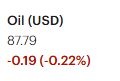
Oil prices eased during the session amid reports concerning the Strait of Hormuz and developments involving Iran and the United States. Reports that Iran had offered to reopen the strategic waterway within seven days, subject to a reduction in U.S. attacks, contributed to the decline in oil prices.
Lower oil prices can have different effects across the market. Energy producers may face pressure when crude prices decline, while lower energy costs can benefit some businesses and consumers. Traders should therefore continue to monitor developments in the oil market alongside geopolitical news.
Technical Market Picture
The technical picture remains mixed across the major indexes.
The Nasdaq Composite extended its winning streak to four consecutive sessions and is now trading comfortably above both its 25-day and 50-day moving averages. The S&P 500 is also clearly above its 25-day and 50-day moving averages.
The Dow Jones, however, remains slightly below both its 25-day and 50-day moving averages, while the Russell 2000 remains below those same shorter-term measures despite being Tuesday’s strongest-performing major index.
All four major indexes remain well above their respective 200-day moving averages.
This creates an interesting divergence: the Nasdaq and S&P 500 have regained their shorter-term technical momentum, while the Dow and Russell 2000 have yet to reclaim both shorter-term moving averages.
Key Takeaways for Traders and Investors
- The indexes remain mixed: Nasdaq and Russell 2000 gained, the Dow declined and the S&P 500 was essentially unchanged.
- Nasdaq leadership continues: The Nasdaq advanced for a fourth consecutive session and remains above its 25-day and 50-day moving averages.
- Small caps showed relative strength: The Russell 2000 gained 0.51%, although it remains below its 25-day and 50-day moving averages.
- Market breadth was positive: Advancers outnumbered decliners on both the NYSE and Nasdaq.
- Market internals are improving: New 52-week lows still exceed new highs, but the gap has narrowed significantly compared with last week.
- Volume increased: NYSE volume rose approximately 9% and Nasdaq volume approximately 5%.
- Semiconductors and storage stocks regained momentum: SNDK, MU, STX and WDC all posted substantial gains and deserve attention for follow-through.
- Financials remained under pressure: The sector declined 1.52%, making it one of Tuesday’s weakest major sectors.
- Technology remains an important source of leadership: Strength in semiconductor and data-storage stocks helped support the Nasdaq.
- The 200-day moving average remains important: All four major indexes remain above this longer-term trend measure.
- For traders, confirmation matters: Tuesday’s combination of positive breadth, higher volume and strength in technology stocks is constructive, but continued improvement in the new-high/new-low balance would provide additional evidence that market internals are recovering.
.
NOTICE TO READERS
The Canadian Vanguard Stock Market is about empowering you to build and manage your wealth by yourself. There is certainly no magic in managing finances or wealth but one needs to know what to do and commit to doing what is needed. When you are ready to start the journey to Take Charge and Put Your Destiny In Your Own Hands, start with reading The Canadian Vanguard every market day. If and when you need more related information or to advertise your business products or services in The Canadian Vanguard, Contact Us
Our readers are strongly advised to conduct their own research into individual stocks before making a purchase decision. In addition, investors are advised that past stock performance is no guarantee of future price appreciation. Any recommendation is not a guarantee of any particular stock’s future prices, and The Canadian Vanguard accepts no responsibility or liability for investors’ or readers’ purchases.
Stocks In The News/ Stocks To Watch and Market Strategy will soon be available only to Paying Subscribers. The dollar sign “$” in the Toronto Market section in the articles only stands for Canadian dollar and in the US market section “$” stands for US dollar.
(c) This article is published by The Canadian Vanguard on September 22, 2026